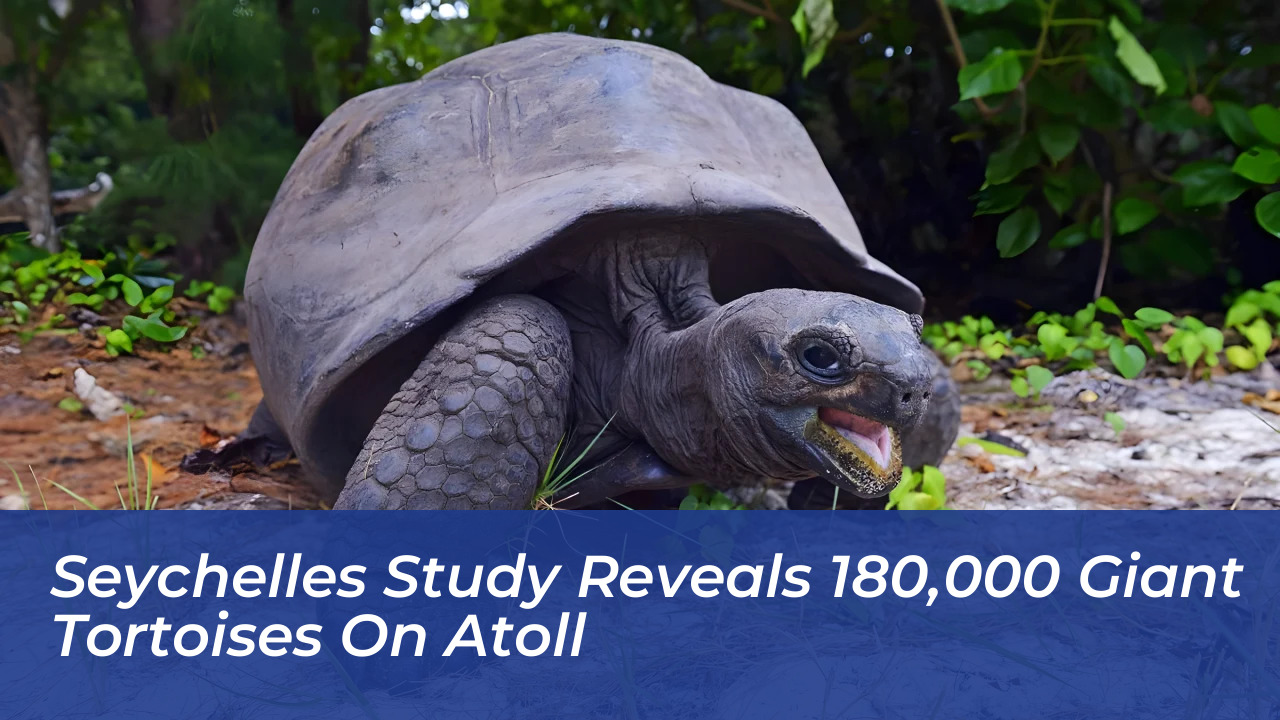

A comprehensive new study has revealed that the world’s largest free-roaming giant tortoise population is thriving beyond previous expectations. Researchers estimated that approximately 180,000 Aldabra giant tortoises (*Aldabrachelys gigantea*) live on the Aldabra Atoll in the Seychelles. This population outnumbers the human population of the entire island nation.
The survey, published in the scientific journal Ecology and Evolution, was a collaborative effort between the Seychelles Islands Foundation (SIF) and the United Kingdom’s University of Exeter. The findings provide the most accurate population baseline for the species to date. They surpass the widely cited estimate of 100,000 tortoises recorded during the late 1990s.
A Monumental Recovery From Historical Exploitation
The scale of the current population represents a triumph for ecological preservation. During the 19th century, heavy hunting and commercial exploitation pushed the Aldabra giant tortoise to the brink of extinction. Fewer than 1,000 animals survived on the atoll.
Strict nature conservation protections reversed this decline. Officials turned the area into a strict nature reserve in 1981 and a UNESCO World Heritage Site in 1982. Dr. Frauke Fleischer-Dogley, CEO of the SIF, hailed the milestone as wonderful news.
“More than 180,000 giant tortoises roaming freely on our atoll is proof of what long-term commitment to conservation can achieve,” said Dr. Fleischer-Dogley. “This is wonderful news for Seychelles, for the world, and for everyone who has worked to protect Aldabra.”
Advanced Modeling Overcomes Dense Terrain
Conducting a census across the remote coral atoll presents logistical challenges. The atoll comprises the main island of Grande Terre alongside Picard, Malabar, and Polymnie. Between 2018 and 2022, researchers executed multiple counting rounds across the rugged landscape.
Aldabra features dense vegetation that often conceals the reptiles. To overcome this, the research team used advanced statistical modeling. By factoring in animals hidden in the thicket alongside direct field observations, scientists calculated a stable population estimate of nearly 183,000 adult and sub-adult tortoises, predominantly residing on Grande Terre.
Dr. Nancy Bunbury, a co-author of the study, noted that long-term monitoring programs historically faced obstacles due to thick foliage. However, modeling unseen animals has established a reliable benchmark to track future demographic changes.
Ongoing Threats From Climate Change and Invasive Species
Despite the inspiring population numbers, researchers emphasize that vigilance remains critical for the long-term survival of the species. Aldabra Atoll faces mounting environmental challenges driven by global climate change.
- Climate Pressures: Longer and more frequent droughts threaten to diminish food sources and cooling shade. Rising sea levels also endanger low-lying coastal sectors.
- Invasive Mammals: Feral goats were successfully eradicated from the atoll in 2012, removing a major competitor for vegetation. However, introduced cats and black rats continue to inhabit the island and prey on tortoise eggs and hatchlings.
Scientists argue that eradicating these remaining invasive mammals is a vital next step. Doing so will remove final barriers to population growth and help the ecosystem withstand future climate stress. As large herbivores, Aldabra giant tortoises play a critical ecological role. They shape vegetation, cycle nutrients, and disperse seeds across the landscape, making their ongoing preservation vital for broader island biodiversity.