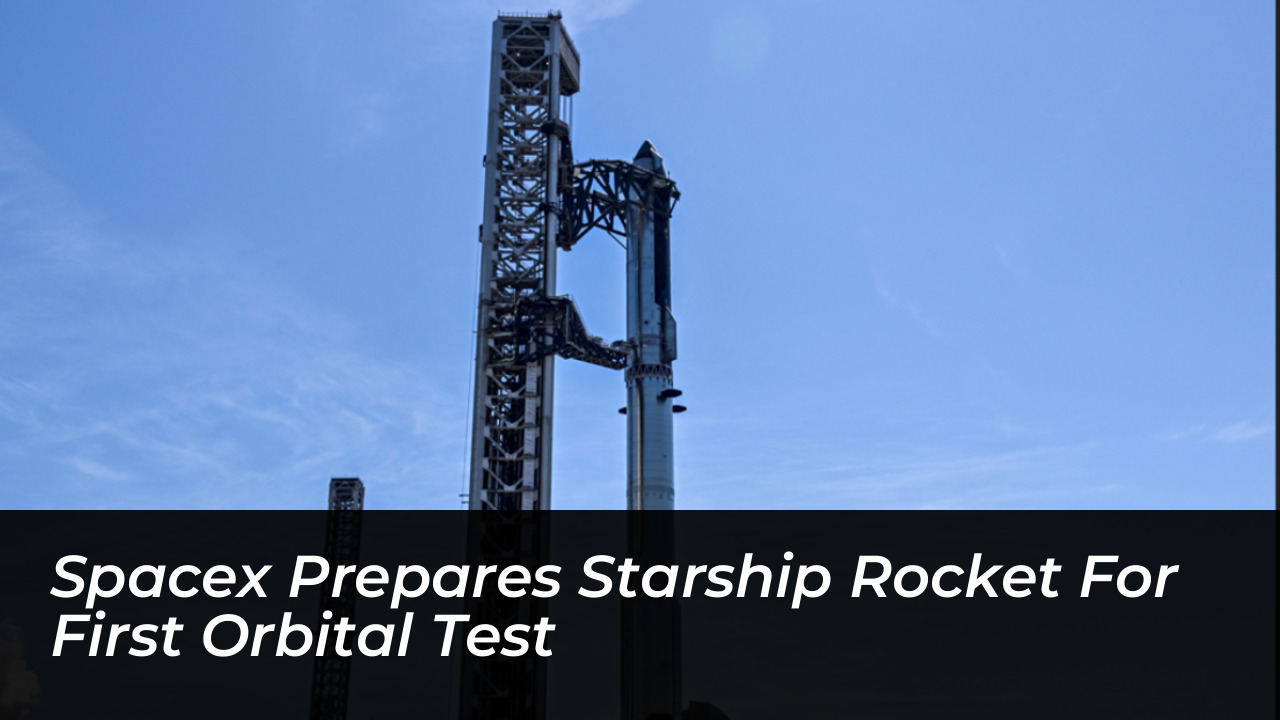
SpaceX is preparing to launch its Starship spacecraft into Earth’s orbit for the first time from the Starbase facility in Cameron County, Texas. This uncrewed mission follows 13 previous suborbital tests that did not achieve continuous orbital flight. Liftoff is targeted for 07:46 local time (13:46 BST), with a 75-minute launch window beginning at 07:15 local time, following Federal Aviation Administration license authorization on September 26.
The mission profile tests the operational capabilities of the world’s most powerful rocket. Shortly after liftoff, the vehicle will rely on its 33-engine Super Heavy first-stage booster. The booster will separate from the upper spacecraft, perform a boostback and landing burn, and splash down in the Gulf of Mexico approximately seven minutes after launch.
Following separation, the upper-stage Starship will travel at roughly 17,500 mph at an altitude exceeding 170 miles. Initially, the spacecraft will follow a “passively safe” suborbital free-return path, providing an abort option if technical issues arise. If health checks are successful 25 minutes into the flight, the spacecraft will fire a Raptor sea-level engine to perform a circularization burn, placing Starship into orbit for the first time.
10-Hour Flight Plan and Payload Deployment
The test flight is scheduled to last just under 10 hours, during which the spacecraft will complete approximately six orbits. About 34 minutes into the flight, Starship will deploy 26 next-generation Starlink V3 satellites. This marks the first time operational Starlink satellites are placed directly into orbit by the vehicle, expanding SpaceX’s network, which currently includes over 11,000 active satellites.
Manufactured in Redmond, Washington, the Starlink V3 satellites feature larger solar arrays that generate twice the power of previous generations, enabling faster data transmission. SpaceX founder Elon Musk stated that this mission is a critical step in scaling the company’s connectivity network.
Advancing Reusability and NASA Artemis Missions
Securing a successful splashdown for both stages is a primary objective as SpaceX works toward a fully and rapidly reusable vehicle. Full reusability is essential to reducing launch costs and accelerating development for future missions.
This orbital test also supports NASA initiatives. SpaceX is preparing Starship for a major NASA test flight next year to support the Artemis program, which intends to use the spacecraft to return U.S. astronauts to the lunar surface. SpaceX COO Gwynne Shotwell has also noted potential future applications, including the deployment of AI compute satellites by 2027.
The mission will conclude with a deorbit burn, followed by atmospheric reentry and a planned splashdown in the Pacific Ocean west of Chile. Flight controllers will monitor telemetry data from more than 500 onboard sensors measuring temperature, pressure, and acceleration throughout the flight.