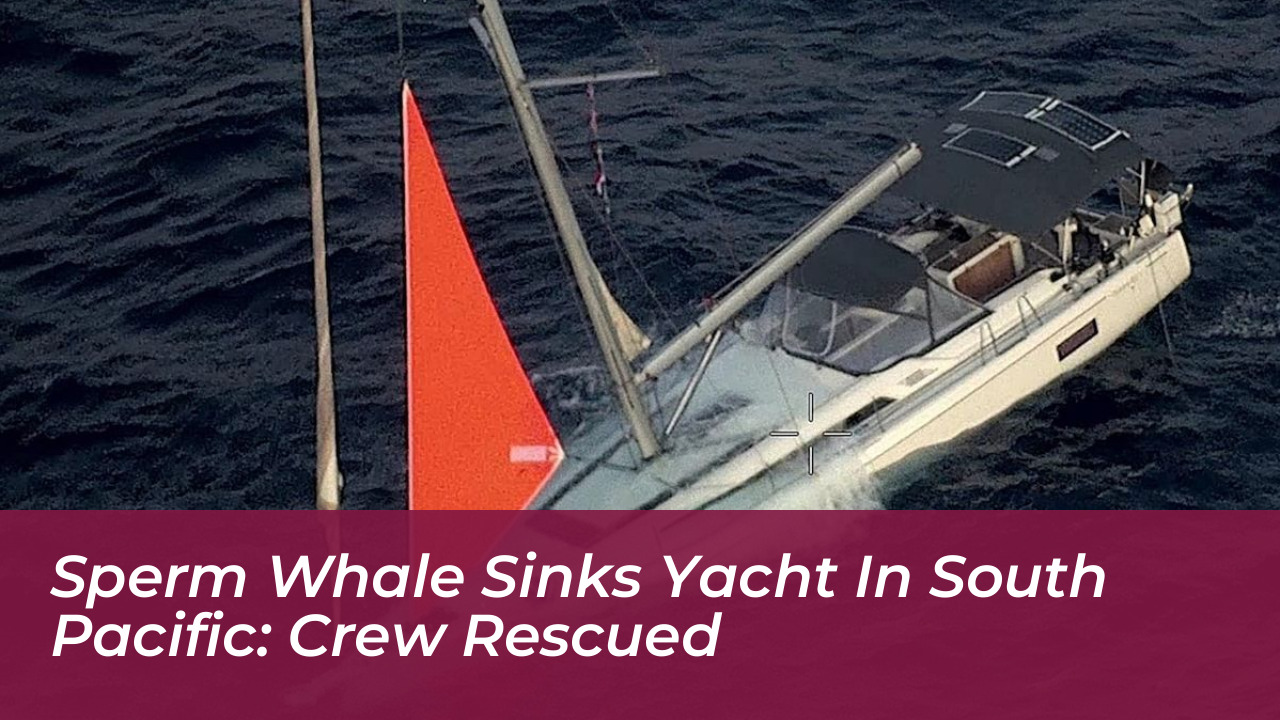
Four sailors survived a harrowing day-and-night ordeal in the open ocean after a pod of sperm whales rammed and sank their 16-meter yacht in the remote South Pacific. The dramatic maritime emergency unfolded 250 nautical miles north of tiny Norfolk Island, leaving the crew stranded in a life raft before a coordinated international rescue operation brought them to safety.
A Sudden Impact on the High Seas
The incident began when the yacht Tai Tam was jolted by a violent, unexpected blow. Australian crew member Jemma Cooper, who was manning the steering wheel at the time, recalled the terrifying moment the vessel was forcefully shoved sideways.
“There was sort of a loud thud. The whole boat was pushed sideways,” Cooper said. After noticing a brown discoloration in the water, she spotted the marine mammals. “We looked out to our port side, and there were six to eight, a pod, of whales there. So then it became clear that that’s what it was.”
Her husband, Jeremy Cooper, was sleeping below deck when the collision occurred and immediately realized the gravity of the situation. An inspection revealed that the starboard steering gear was completely smashed, and significant volumes of water were pouring into the hull through multiple gashes and cracked fiberglass structures.
The Fight for Survival
Recognizing the immediate danger, the crew activated their emergency beacon at 1:00 p.m. New Zealand time on Saturday, roughly 30 minutes after the strike. New Zealand crew member Terry Hetherington confirmed that the group declared a full mayday as they battled rising waters.
French crew member Martin Jaffre worked frantically to slow the flooding using expansion foam and even swam underneath the vessel to inspect the structural damage. Despite hours of manual bailing and trying to keep the engine clear, the damage proved fatal for the vessel.
Late Saturday night, in calm seas under a full moon, the four sailors abandoned the sinking Tai Tam and boarded a life raft. Fearing the tether might drag them down as the boat went under, they cut the line. Shortly afterward, the yacht slipped beneath the waves.
An 18-Hour Rescue Operation
The Rescue Coordination Centre New Zealand swiftly mobilized assistance. The Royal New Zealand Air Force deployed a P-8A Poseidon patrol plane to establish radio communication and track the exact coordinates of the life raft.
The 18-hour operation concluded at 6:00 a.m. on Sunday when a passing 143-meter container ship, the MV Sofrana Surville, intercepted the life raft. All four crew members successfully scaled a ladder to safety, where they were greeted with warm coffee and a debriefing with the ship’s captain.
Mike Clulow, Operations Manager for the Rescue Coordination Centre, commended the sailors for their preparedness. He highlighted that the early activation of their Emergency Position-Indicating Radio Beacon (EPIRB) was vital to their survival.
“The crew of the yacht did all the right things, and it was unfortunate to have struck a whale in open water,” Clulow said. “They were well prepared, and the early activation of their EPIRB was key to helping get them to safety.”
Marine Context and Vulnerability
Adult male sperm whales typically measure between 50 and 60 feet in length and are classified as a vulnerable species by the International Union for Conservation of Nature (IUCN). Marine experts note that while direct interactions resulting in vessel sinkings are rare, the species faces ongoing threats from ocean noise pollution, plastic ingestion, and accidental ship strikes.
Reflecting on the dramatic conclusion to their holiday voyage, Jeremy Cooper expressed immense relief despite the loss of their vessel. “It was wonderful, wonderful, and just a terrible, terrible ending-but luckily no loss of life.”