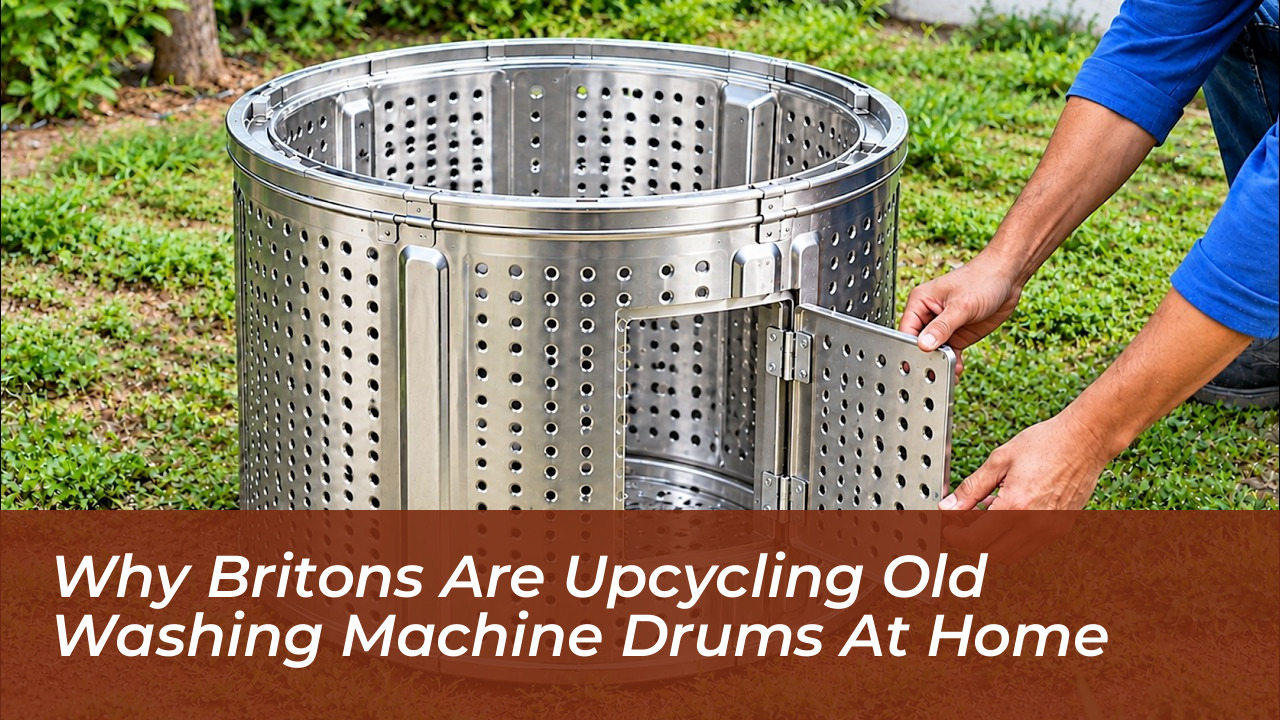

That broken appliance headed for your local council tip contains one of the most durable, high-grade fabrication materials sitting in modern homes. It is a perforated, marine-grade stainless steel cylinder capable of withstanding extreme heat, rust, and mechanical stress. Before booking a bulky waste collection or consigning your white goods to a scrap merchant, taking out the central drum can unlock an exceptionally versatile component for domestic workshops, outdoor living, and heavy-duty storage.
Every year, thousands of domestic appliances are discarded across the UK under Waste Electrical and Electronic Equipment (WEEE) guidelines. Yet, while electric motors burn out and plastic fascia panels crack, the inner cylinder remains virtually indestructible. Engineering enthusiasts and home craftspeople increasingly treat these salvaged parts as high-value raw material rather than household rubbish.
The Engineering Hidden in Plain Sight
Washing machine manufacturers build the internal basket to endure thousands of violent spin cycles while submerged in hot water and caustic detergents. To achieve this durability, makers construct the drum from heavy-gauge stainless steel, heavily perforated with hundreds of pressed holes that allow optimal liquid flow.
In a fabrication setting, those exact features translate into immediate structural advantages. The perforation pattern delivers effortless multi-directional ventilation. This makes the component an ideal combustion vessel or a high-capacity air-drying container. Because the metal resists oxidation far better than mild steel, it survives prolonged exposure to wet British weather without disintegrating into flaky rust.
Core Properties That Make Drum Scrap Valuable
- Extreme Thermal Resistance: High-grade stainless alloys tolerate intense temperatures without warping or burning through.
- Pre-drilled Airflow: Uniform perforations act as a passive draft system, providing consistent oxygen circulation for clean burns.
- Structural Rigidity: The rolled rims and deep internal ribs grant substantial weight-bearing capacity despite low total mass.
- Corrosion Immunity: Outdoor exposure rarely compromises the metal, ensuring years of functional service in unheated sheds or open gardens.
Transforming Scrap Metal into Practical Household Inventions
The most popular domestic conversion is the high-efficiency smokeless patio brazier. By mounting a salvaged washing machine drum onto sturdy metal legs or a scrap wheel rim, the built-in perforations act as an engineered draft system that feeds air directly into the base of the fire. The result is a cleaner burn, significantly reduced smoke drift, and a distinctive amber glow radiating through the patterned steel mesh.
Beyond garden heating, experienced tinkerers utilise the cylinder as a heavy-duty workshop separator. Mounted on a central axle, the revolving cage becomes an effective soil riddle for the allotment, a tumbling cleaner for rusty hardware, or a durable catch basin for metal filings. The material also excels in creative domestic storage, easily converting into a rustic side table, a subterranean wine-cellar rack, or an indestructible mobile hose reel.
Essential Safety Protocols for Home Fabricators
Transforming appliance scrap requires strict workshop precautions. Deconstructing a washing machine exposes internal concrete counterweights, tension springs under severe load, and razor-sharp sheet metal edges hidden behind the outer cabinet. The Health and Safety Executive (HSE) consistently advises using robust personal protective equipment (PPE) whenever angle grinders, drill presses, or welding gear touch recycled scrap metal.
- Edge Protection: Never handle freshly cut stainless steel without heavy leather rigger gloves. Sheared drum lips can slice through ordinary textiles instantly.
- Decontamination: Thoroughly pressure-wash the interior and rear spider bracket to remove decades of chemical detergent residue, limescale, and microplastic grime before applying high heat.
- Eye and Ear Defence: Stainless steel work-hardens rapidly during cutting, throwing white-hot sparks and generating deafening friction noise that demands rated eye goggles and ear defenders.
The next time an old appliance gives up the ghost, pause before letting the council truck cart it away into the aggregate stream. With basic hand tools, protective gear, and a single free afternoon, you can turn a piece of domestic scrap into a functional masterpiece built to last decades. Upcycling heavy metal requires a little mechanical confidence, but the enduring utility of stainless steel makes every cut worthwhile.