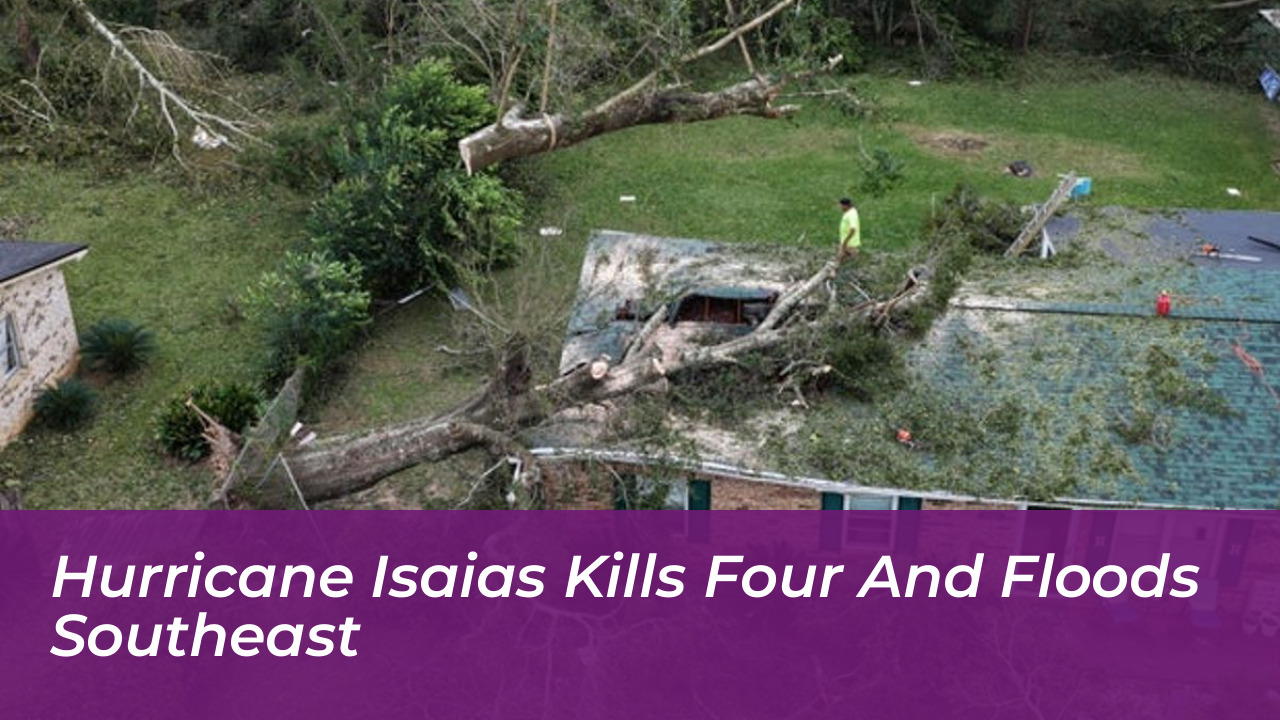

Hurricane Isaias left at least four people dead, severely damaged homes and infrastructure, and disrupted electricity for hundreds of thousands of residents across Florida and Alabama after making landfall near Destin, Florida. As the powerful storm moved north through the Southeast over the weekend, its remnants triggered dangerous flooding and landslides in North Carolina. Simultaneously, former Tropical Storm Rachel brought destructive surf, heavy rain, and coastal flooding to Southern California and the Southwest.
Authorities confirmed two storm-related deaths in Florida and two in Alabama linked to Isaias. By Monday morning, tracking data from PowerOutage.us indicated that more than 150,000 electricity customers in Florida and over 20,000 in Alabama remained without power, while recovery crews worked around the clock to clear debris and restore critical services.
In Escambia County, Florida, Sheriff Chip Simmons reported that a woman died when a tree fell directly onto her home. In a separate incident, a man succumbed to carbon monoxide poisoning caused by a portable generator operating inside his garage. In Birmingham, Alabama, Fire Chief Cory Moon confirmed another fatality after a falling tree struck a residential home. Additionally, Josh Johnson of Alabama’s emergency management agency attributed a fourth death to a severe vehicle crash involving a fallen tree across a roadway in Barbour County.
Widespread Power Outages and Regional Impacts
At the peak of the disruption, approximately 670,000 residents across Florida, Alabama, Georgia, and Mississippi were left without electricity as Isaias weakened from a Category 2 hurricane to a post-tropical cyclone. Power outage tracking figures showed roughly 420,000 customers affected in Florida, 190,000 in Alabama, 43,000 in Georgia, and 17,000 in Mississippi.
President Donald Trump approved emergency declarations for Florida, Alabama, and Georgia, releasing federal resources to support rapid disaster response and recovery efforts. Homeland Security Secretary Markwayne Mullin confirmed that state and federal assets were heavily deployed. Meanwhile, Florida Governor Ron DeSantis noted during a press briefing in Tallahassee that approximately 16,000 utility linemen had staged ahead of landfall to accelerate power restoration efforts once winds subsided.
Infrastructure suffered notable blows across the Florida Panhandle. The mayor of Pensacola noted drinking water shortages in the coastal city, while Pensacola Airport-the state’s 10th-largest-was forced to close temporarily for commercial flights while damage assessment teams inspected runways and terminal facilities.
Tropical Storm Rachel Batters Southern California
While the Southeast grappled with hurricane-force winds and torrential downpours, a separate weather system on the West Coast brought severe weather hazards. Tropical Storm Rachel advanced toward northern Baja California and Southern California, delivering high winds, elevated ocean levels, and powerful swells.
The National Weather Service issued a Coastal Flood Warning for Huntington Beach and surrounding coastal communities, where surf heights reached 5 to 7 feet with occasional sets pushing up to 9 feet. The severe weather and rising tides left approximately 7,000 customers temporarily without power in parts of Southern California, prompting local officials to urge residents to avoid low-lying waterfront areas and flooded roadways.
Energy Sector and Gulf Operations
The dual weather events also impacted energy production in the Gulf of Mexico. Major energy producers, including Shell and Chevron, initiated plans to redeploy personnel back to offshore platforms such as Mars, Olympus, Ursa, Vito, and Appomattox as conditions improved. However, the Marine Minerals Administration reported that roughly 69% of oil output and 57% of natural gas production in the U.S. Gulf of Mexico remained shut-in, with 113 production platforms-about 30% of the regional total-temporarily evacuated.
To mitigate potential supply chain disruptions, the U.S. Department of Energy authorized an emergency release of up to 4 million barrels of crude oil from the Strategic Petroleum Reserve. Emergency management officials continue to urge caution as communities across both coasts navigate ongoing post-storm hazards, flooded infrastructure, and recovery operations.