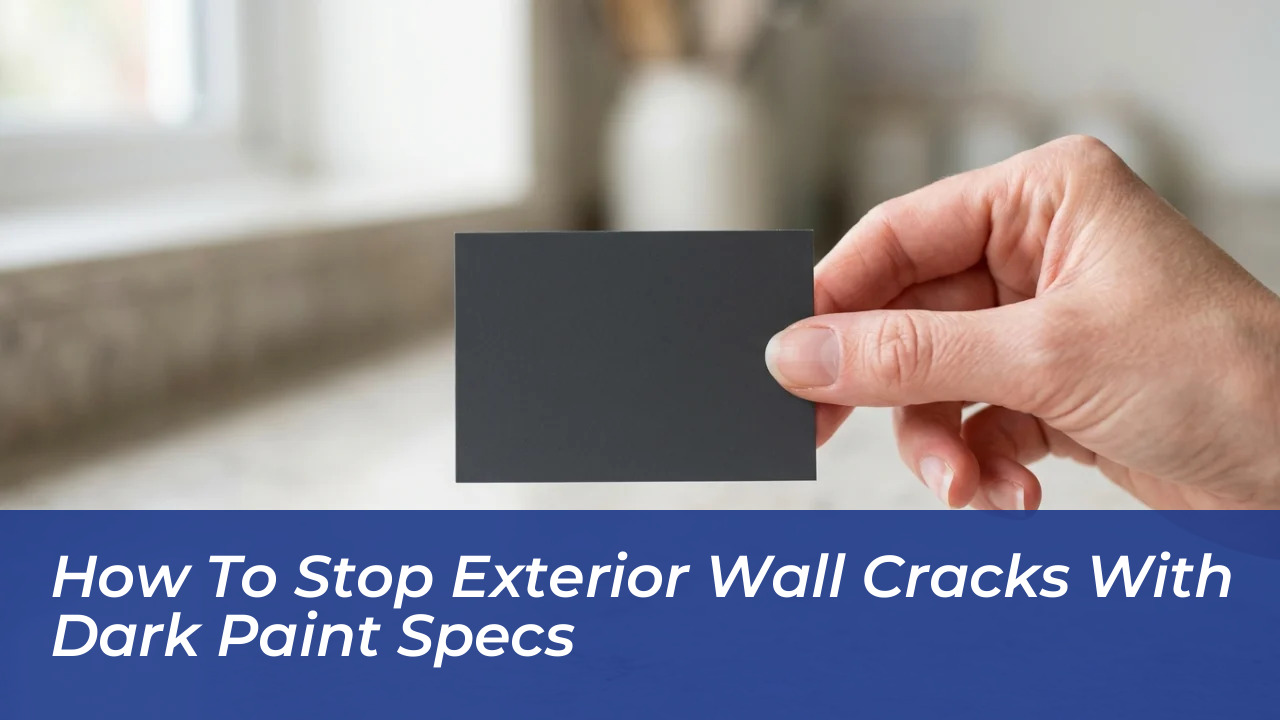

A dark exterior coating paired with a simple product data sheet holds the key to protecting an exposed building facade from catastrophic cracking, peeling, and colour degradation. Dark shades soak up intense solar radiation, pushing wall surface temperatures up by as much as 30 °C compared to white surfaces. To prevent premature failure, technical building standards dictate that finished exterior coatings must strictly maintain a solar absorption coefficient of 0.7 or lower. Without checking this single metric before painting, sunny external walls face relentless thermal expansion cycles that tear coatings apart.
The Anthracite Trend Meets the Afternoon Sun
Anthracite grey and deep slate tones remain massive favourites for modern exterior renovations. Yet, homeowners frequently find that just a couple of hot summers leave sunny elevations-particularly west-facing walls-marred by patchy shading, micro-cracks, and coating detachment. This is not bad luck; it is fundamental physics. A dark hue absorbs raw solar radiation, accumulates intense heat, and expands significantly. When temperatures plunge in the evening, the surface rapidly contracts. Over dozens of consecutive sunny days, this continuous thermal shock forces the underlying masonry and render to flex beyond their physical limits.
Dark tones increase thermal stress and thermal variation across the substrate, accelerating patchy shading, visible micro-cracks, and salt efflorescence. Specialist building research from the Belgian CSTC (Scientific and Technical Centre for Construction) reveals that an identical wall section can experience a 20 °C to 30 °C temperature gap purely based on whether it is finished in white or a dark shade. On porous substrates like brickwork, blockwork, and mortar render, that trapped heat does not stay on the surface-it destabilises the entire structural face.
The 0.7 Threshold Written Into Technical Standards
In professional construction codes, such as the European standard NF DTU 26.1 for mortar-based renders, the solar absorption coefficient of a finished coating is capped at 0.7. The scale runs from 0 to 1:
- Pure white sits near 0.18, deflecting the vast majority of incoming solar energy.
- Traditional black reaches up to 0.94, absorbing nearly every ray of light that strikes it.
Standards governing exterior coatings apply strictly to finishes with an absorption value under 0.7. Because solar reflectance equals 1 minus absorption, this requirement mandates a total solar reflectance of at least 30%. Coating manufacturers like Tollens equally benchmark this against the luminance value, formally advising against exterior paints where the Y luminance index falls below 35 on exposed elevations.
Traditional Pigments vs Solar-Reflective Technology
A widespread misconception assumes that achieving a fashionable charcoal or deep brown finish automatically puts exterior plasterwork at risk of heat-induced destruction. While this was historically true with standard carbon-based colourants, chemical engineering has changed the formula through infrared-reflective pigmentation. Specialist manufacturers now formulate dark mineral renders and exterior paints using pigments specifically designed to bounce away invisible infrared solar rays while maintaining a deep, saturated tone to the human eye.
| Pigment Technology | Total Solar Reflectance |
|---|---|
| Standard Black Pigment | 3% |
| Controlled-Reflection Black | 34% |
| Standard Brown Pigment | 25% |
| Controlled-Reflection Brown | 57% |
Testing data from industrial paint specialists highlights the dramatic performance divide. While conventional black pigments reflect a meagre 3% of total solar energy, controlled-reflection formulas boost that figure to 34%, comfortably beating the minimum 30% reflectance threshold. Render producers such as Weber, alongside coatings brands including STO and Seigneurie, now produce dark palettes that comply fully with high-exposure technical limits.
How to Verify Your Paint Before Starting the Job
Checking whether a selected shade will ruin an exterior wall takes only a few minutes before opening a tin or mixing a batch of mineral render. Locate the official manufacturer technical data sheet for the exact product code, rather than trusting a digital screen or printed colour card. Look up the solar absorption coefficient to verify it measures equal to or below 0.70. Alternatively, check that the Y luminance value is 35 or higher, or verify that total solar reflectance exceeds 30%.
Inspect the colour card for warning pictograms, which manufacturers use to flag tones unsuitable for direct sunny exposures. Planning rules and local authority conservation guidance also frequently regulate dramatic changes to exterior wall colours, making technical verification vital before any scaffold goes up. Always inspect the specific technical sheet of your chosen batch, as even minor shade variations can push a formulation across the 0.7 limit. Pay close attention to south- and west-facing elevations, which endure the highest thermal loading during peak afternoon heatwaves. If your property features modern dark masonry, share your experiences with us regarding how your exterior render has weathered the summer sun over time.