
Compacted earth rammed tightly into discarded vehicle tyres forms the dense backbone of the Earthship home. This innovative off-grid architectural concept was pioneered by American architect Michael Reynolds. Set against the high desert backdrop of Taos, New Mexico, these low-carbon structures harness everyday scrap materials alongside the sun, wind, and rain to maintain comfortable indoor temperatures without relying on standard utility grids. What began in the early 1970s as a modest experiment with discarded beverage cans has evolved into an internationally recognized blueprint for sustainable shelter.
Rising utility bills, environmental degradation, and housing affordability crises have driven a surge of global interest in alternative building methods. The core premise behind Reynolds’ concept is simple: treat municipal refuse not as waste destined for landfills, but as high-performance building blocks that naturally buffer against extreme exterior weather. Rather than depending on energy-intensive central heating or conventional air conditioning, an Earthship relies on heavy thermal mass and passive solar principles to regulate interior climates.
From Discarded Drink Cans to Load-Bearing Tyre Walls
The concept took shape after Michael Reynolds graduated with an architecture degree from the University of Cincinnati in 1969. Confronted by mounting consumer waste, he initially turned to discarded packaging for structural solutions. By 1973, he had patented an innovative construction block fabricated from empty tin and steel cans bound securely together with wire.
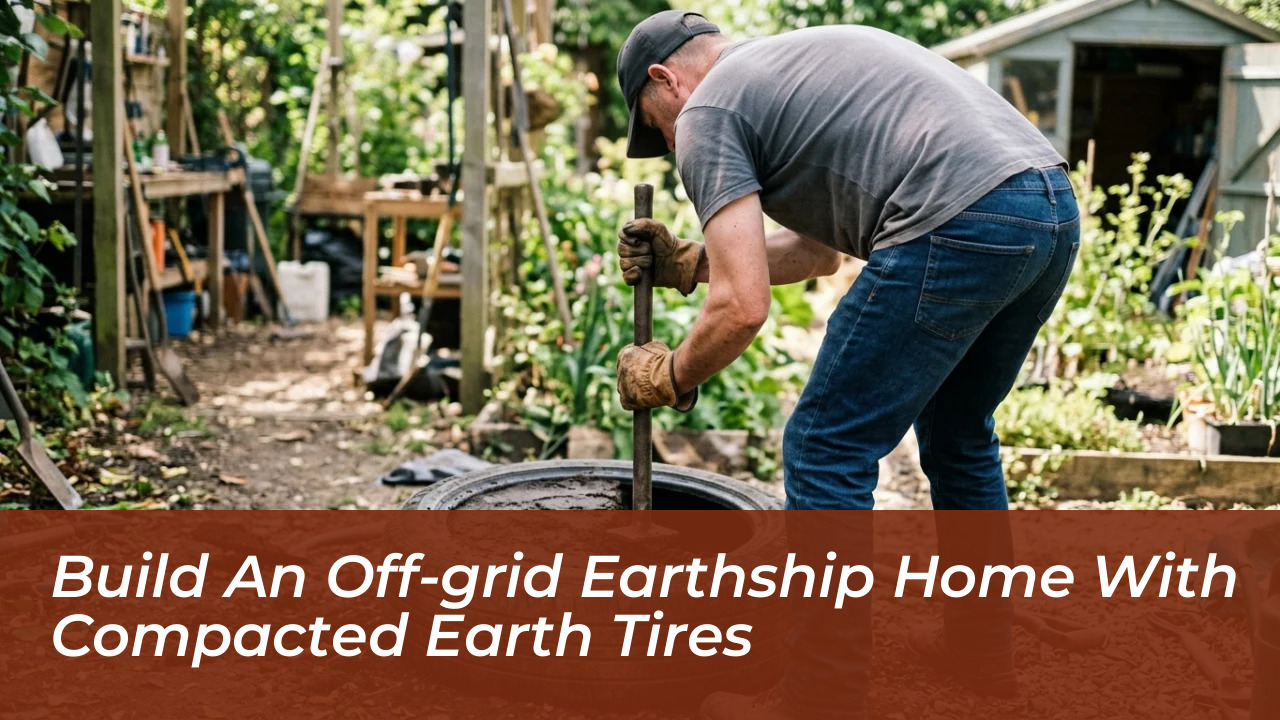
As the architectural designs evolved, Reynolds turned his attention toward a heavier, more problematic waste stream: scrap car tyres. By pounding earth tightly into each casing, construction teams create dense structural units capable of supporting multi-storey dwellings while easily resisting external climate swings. These load-bearing and retaining walls utilize rammed earth clad with steel-reinforced recycled tyres.
Beyond structural rubber, non-structural partitions incorporate glass bottles and metal drink cans embedded directly into bonding mortar. When cut and joined, colored glass bottles function much like stained-glass masonry, allowing natural daylight to filter through interior walls while significantly reducing the volume of commercial cement required.
The Engineering Framework: Six Functional Pillars
An authentic Earthship home operates as an independent ecological organism governed by six interconnected architectural principles. These systems eliminate reliance on municipal mains connections by harvesting every vital resource directly on-site:
- Passive Heating and Cooling: Massive tyre walls store ambient thermal energy, while south-facing glazing captures maximum solar gain. Buried cooling tubes pull fresh air through underground runs to chill incoming airflow naturally during scorching summer months.
- Solar and Wind Power: Roof-mounted photovoltaic panels and small wind turbines generate clean electricity to run internal household appliances and lighting fixtures.
- Rainwater Harvesting: Sloped roofs channel rain and snowmelt into dedicated cistern tanks, where mechanical filtration makes the supply safe for everyday household use.
- Internal Food Production: Integrated interior greenhouses produce fresh crops-including tomatoes, peppers, cucumbers, and herbs-nourished directly by treated household greywater.
- Wastewater Treatment: Self-contained indoor treatment cells safely recycle greywater through interior planters before redirecting it for secondary tasks like toilet flushing.
- Recycled Building Elements: Reclaimed steel, aluminum, and rubber divert thousands of discarded items directly away from municipal waste streams.
Separating Thermal Mass From Conventional Insulation
A frequent misconception among amateur builders is that stuffing earth into tyre walls acts purely as high-performance insulation. In practice, rammed earth provides heavy thermal mass rather than classic barrier insulation. It absorbs ambient heat slowly during peak sunlit hours and steadily radiates that stored warmth back into the living quarters overnight as external temperatures plunge.
Recent scientific analyses, including landmark structural testing conducted by Australian researchers at the University of South Australia, have given engineers the hard data required to evaluate tire walls. Published in engineering journals, studies confirm that earth-packed tyre walls match the structural soundness of concrete or wood sleeper retaining walls while offering superior seismic resilience. Unlike brittle concrete, tyre walls can flex and bounce back from ground shocks during earthquakes.
Construction Costs and Specifications
Constructing an off-grid vessel of this type requires dedicated manual labor, specialist technique, and precision site planning. Initial guideline figures published for builds in North America indicate price variations based on square footage and technical specifications, with designs adapted internationally across regions including France, Germany, Canada, and Mexico.
| Earthship Model Type | Estimated Baseline Price (USD) |
|---|---|
| Refuge & Encounter Models | Approx. $350 per sq ft |
| Unit Model | Approx. $400 per sq ft |
| Global Earthship Design | Approx. $425 per sq ft |
Final project costs fluctuate based on local planning approvals, ground stability, and regional material availability. Although born in the arid plains of the American Southwest, the underlying engineering has proven adaptable to cooler, wetter climates across Europe and beyond.
Frequently Asked Questions
How long do earth-filled tyre walls last?
Because tyres are buried within walls and covered with earth, plaster, or concrete, they are shielded from ultraviolet (UV) radiation and oxygen. Without exposure to sunlight or open air, rubber tyres encased in earth and plaster will effectively last indefinitely.
Are tyre walls difficult to build?
Building with tyres requires heavy manual labor rather than complex technical skills. A team of two people-one shoveling soil and one pounding with an 8-pound sledgehammer-can pack roughly four tyres an hour after a brief learning curve.
Do toxic chemicals leach from tyres into the home?
In a standard Earthship build, tyres are tightly packed with earth and sealed completely behind thick layers of adobe mud, plaster, or concrete. This barrier prevents direct contact with interior living spaces, mitigating off-gassing and toxicity concerns.
Can Earthships keep warm in winter without a heater?
Yes. Earthships utilize passive solar design and heavy thermal mass walls. South-facing glass captures solar heat during the day, which is stored in the massive earth-filled tyre walls and radiated back into the rooms at night to maintain comfortable living temperatures for free.
Do I need planning permission to build an Earthship?
Because tyre walls fall outside conventional building codes in many jurisdictions, you will need to work closely with local building authorities and secure structural engineer calculations to gain alternative compliance approval before starting construction.