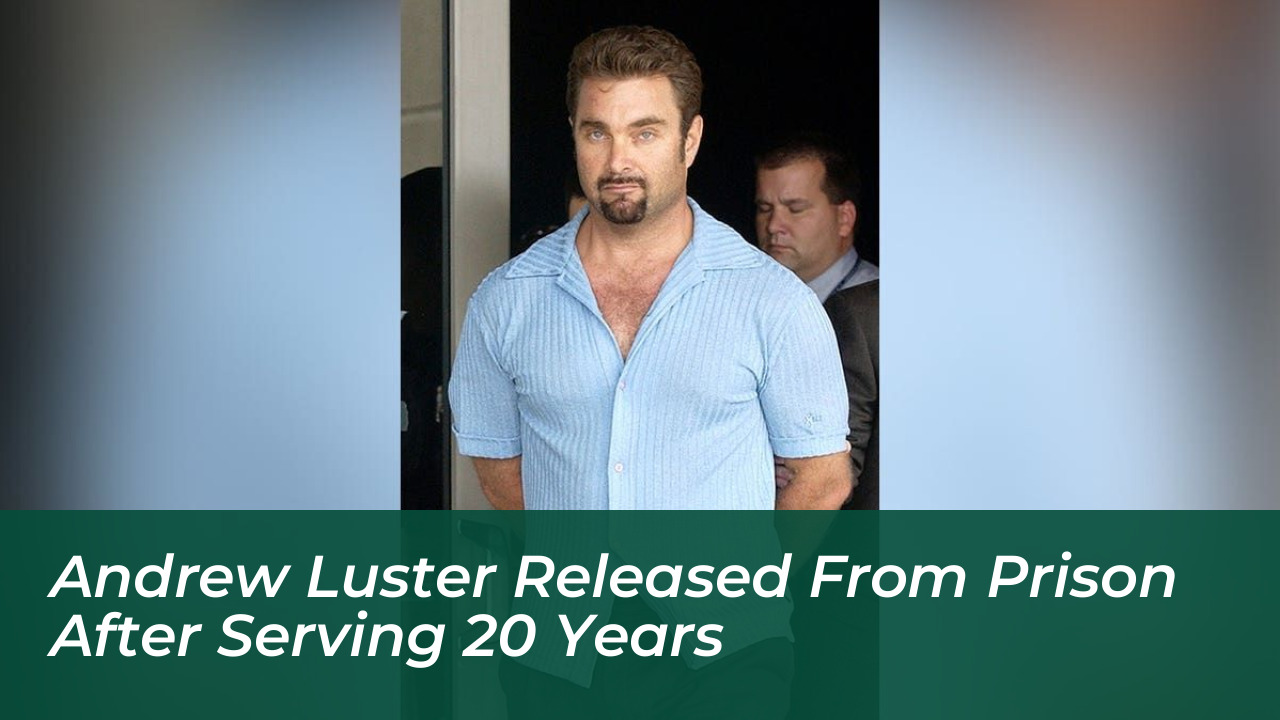

Andrew Luster, the great-grandson of cosmetics mogul Max Factor, has been released from a California state prison. Luster served approximately 20 years of a sentence that was originally slated for 124 years. His release earlier this month has triggered significant backlash from local officials and residents in Glendora, California, where Luster is now residing.
Background of the Conviction
In 2003, Luster was convicted of 86 felony counts, including drugging and assaulting three women at his beachfront home in Ventura County. Prosecutors proved that Luster used the drug GHB to render his victims unconscious before committing the crimes. During his 2003 trial, Luster fled the country while free on $1 million bail, leading to his conviction in absentia. He was eventually apprehended in Puerto Vallarta, Mexico, by bounty hunter Duane “Dog” Chapman.
Legal Challenges and Sentencing
Luster’s initial 124-year sentence was set aside in 2013 after a judge ruled the trial court had not provided adequate justification for the consecutive nature of the sentencing. Although the judge denied Luster’s attempt to overturn his convictions, he was granted a new sentencing hearing and received a reduced term of 50 years.
The California Department of Corrections and Rehabilitation (CDCR) stated that Luster’s release was not an early release but rather the result of serving his full sentence as required by law. His release was achieved through the application of pre-sentence credits and good conduct credits earned while incarcerated, in accordance with voter-approved measures such as Proposition 57.
Public Safety Concerns in Glendora
The presence of a convicted serial rapist in the community has drawn sharp criticism from local leadership. Glendora Mayor David Fredendall expressed the city’s outrage, stating that the community was not adequately prepared for the arrival of an individual convicted of such crimes.
“The City of Glendora is beyond disappointed. We are outraged. The State may argue that this was not technically an early release. It can point to sentencing credits, legal calculations, and administrative requirements. However, those technical explanations do not address the larger concern,” Mayor Fredendall stated.
California Assemblywoman Blanca E. Rubio called the release “disgusting and unacceptable.” Rubio, who co-authored 2024 legislation to reclassify the drugging and assaulting of unconscious victims as a violent felony, noted that the change in law came too late to impact Luster’s sentencing outcome.
Current Status
Luster is currently registered on California’s Megan’s Law database as a offender and is subject to three years of supervised parole. Local law enforcement in Glendora is working with state parole authorities to monitor his compliance with all supervision conditions to maintain public safety.
Frequently Asked Questions
- Why was Luster released after only 20 years? Luster received credit for time served, pre-sentence credits, and good conduct credits, which reduced his 50-year resentenced term.
- Is Luster still on parole? Yes, he is serving a three-year term of supervised parole and must register as a offender for life.
- Did the 2024 law change affect his release? No. While the new law classifies his crimes as violent felonies, it was not retroactive and did not apply to his case.
- Where is Andrew Luster living? Public records indicate he is currently residing in Glendora, California.
- What is the city of Glendora doing about his presence? Local officials have demanded transparency from the state, and the local police department is monitoring his adherence to all parole conditions.