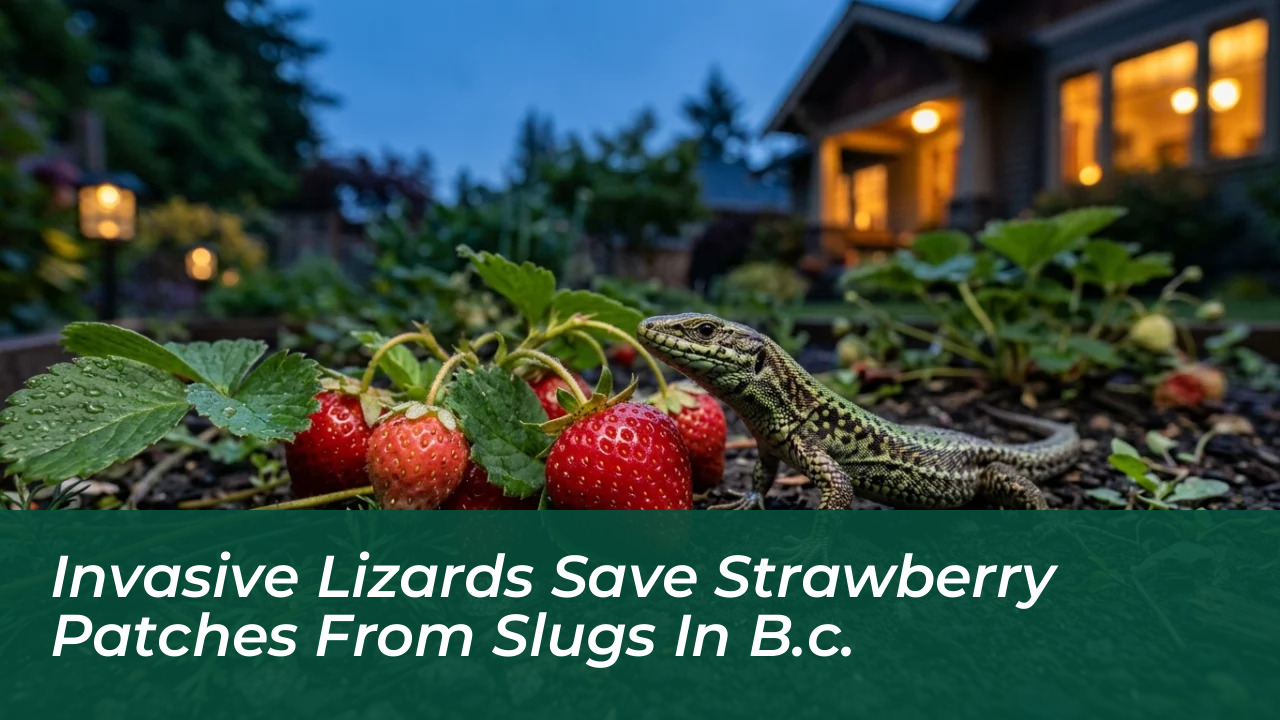

Invasive European wall lizards have begun wiping out garden slugs to protect backyard fruit crops on Vancouver Island. However, vertebrate zoologists warn that their uncontrolled spread is causing severe collateral damage across native food chains. While British Columbia gardeners celebrate pristine strawberry yields, conservationists caution that these non-native reptiles are simultaneously decimating local insects, spiders, and vulnerable baby garter snakes.
For fruit growers grappling with persistent pest infestations, a sudden predator capable of clearing an entire plot of molluscs might seem like an unexpected blessing. Yet beneath this short-term horticultural triumph lies an escalating ecological hazard that researchers say is now virtually permanent across the region.
The Strawberry Patch Miracle: How Non-Native Reptiles Eradicated Slugs
In Saanich, British Columbia, local gardener Tracy Menzies noticed an influx of small reptiles scuttling across her garden beds near the Gorge Waterway. Shortly afterwards, the voracious slugs that had historically destroyed her summer fruit crops vanished entirely from the property.
The reptiles were identified as European wall lizards, an introduced species known for agility and opportunistic feeding habits. Rather than sporadic sightings, the animals established a persistent presence, moving actively underfoot and hunting continuously throughout cultivated beds.
Menzies noted the transformation immediately across her plots:
I don’t have a slug in my yard, so I can only assume, given the start of me seeing the wall lizards, that they’re feasting on the slugs.
While the elimination of slugs delivered an immediate windfall for local food cultivation, museum biologists tracking non-native species point out that predatory benefits in private plots rarely stay contained within backyard boundaries.
The Hidden Cost to Local Wildlife and Ecosystems
Behind the apparent benefit to amateur agriculture, scientific assessments show a starkly different reality. Research teams monitoring the species report that the reptiles are multiplying without meaningful checks, consuming native fauna far beyond common garden nuisances.
Gavin Hanke, curator of vertebrate zoology at the Royal BC Museum, confirmed the scale of the expansion. He noted an estimated population of 800,000 to one million European wall lizards mostly concentrated on Vancouver Island, having spread as far as Campbell River.
They’re spreading fast and furious, and we’re stuck with them. We will have to learn how to live with them.
The wider diet of these agile predators extends well beyond common garden slugs. By hunting daily across established territories, dense populations of wall lizards deplete essential invertebrates that sustain indigenous wildlife, while directly attacking youthful native reptiles.
Hanke added that the lizards heavily impact invertebrate populations and even kill baby garter snakes. This means every individual hunting every day takes a toll on Vancouver Island’s spiders and insects.
Myth vs. Reality: Are Invasive Predators Good Garden Allies?
A widespread assumption among casual growers suggests that any predator feeding on nuisance insects or slugs serves as an asset to domestic gardens. Scientific observation refutes this idea, demonstrating that introduced generalist hunters rarely confine their appetites to targeted pests.
Unlike specialised biological controls, invasive reptiles outcompete endemic predators, exhaust local food reserves, and directly alter established food webs. Nicholas Wong, science and operations manager with the Invasive Species Council of BC, noted that these lizards actively compete with native species for food and space.
Ecological Impact Overview
- Slugs: Eradicated in local plots, successfully protecting vulnerable strawberry patches.
- Native Invertebrates: Substantial decline recorded in local spiders, ants, earwigs, and beneficial insects.
- Indigenous Reptiles: Direct predation observed on emerging baby garter snakes and competition with native lizards.
- Population Control: Species firmly established across the region; long-term eradication is deemed practically impossible.
Origins and Global Parallels of Invasive Reptiles
The population explosion in B.C. originated from an intentional release of just 12 lizards in 1970. This occurred after a roadside zoo, Rudy’s Pet Park in Central Saanich, closed following the death of its owner. Southern Vancouver Island’s cooler winters mixed with hot, dry summers provided an ideal habitat for these creatures native to Italy.
The dynamic unfolding on Vancouver Island reflects widespread patterns observed worldwide when non-native reptiles infiltrate complex habitats. Across various continents and climates, foreign species consistently alter regional balances:
- Southeast Georgia: Over 20 invasive tegu lizards were documented threatening native wildlife across critical habitats.
- Florida: State authorities sanctioned targeted iguana hunting programmes as a formal mechanism for population control.
- Cyprus: Field research revealed that human infrastructure and presence altered agama lizard behaviour patterns in destabilising ways.
- Island Ecosystems Worldwide: Generalist invasive reptiles systematically unseat endemic species by monopolising primary food sources.
Because these predatory reptiles multiply rapidly and survive across suburban environments, natural management remains an ongoing challenge for conservation specialists. Experts advise that homeowners wishing to deter them maintain a stark, well-manicured lawn rather than complex garden mulch that provides shelter, though individual efforts remain limited unless coordinated across entire neighborhoods.