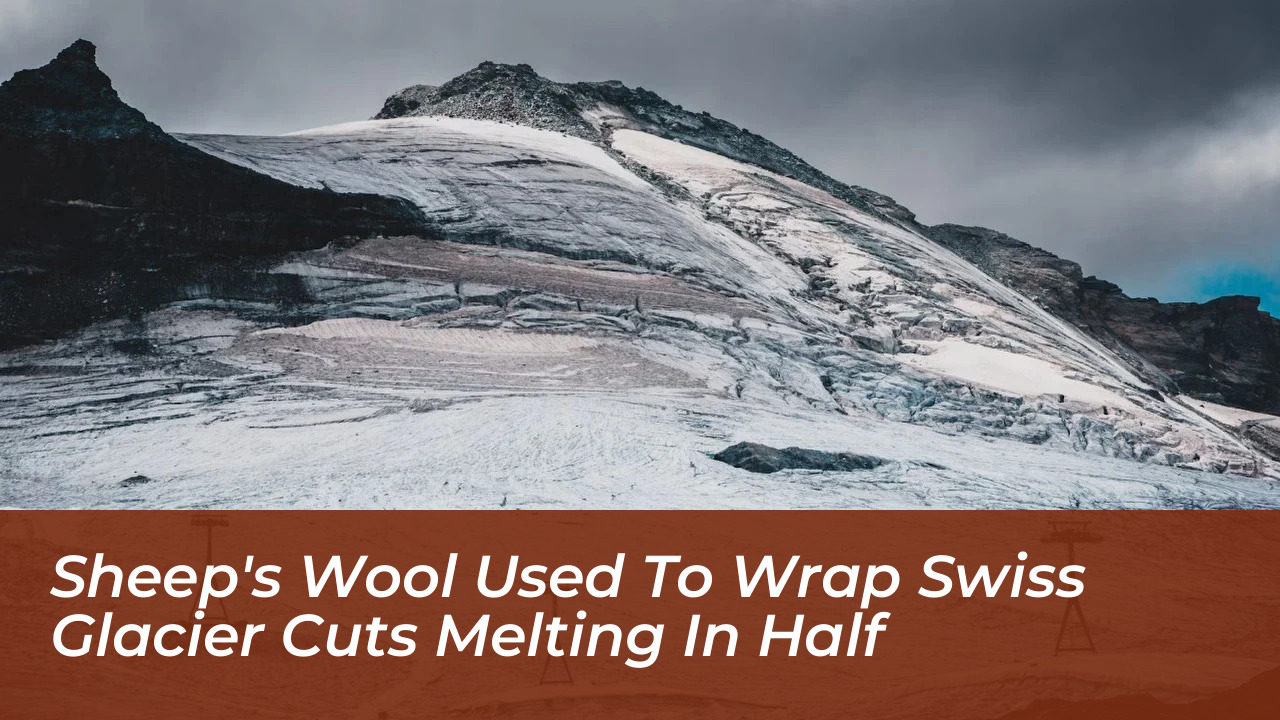

In June, an innovative environmental experiment took shape high in the Swiss Alps as researchers wrapped parts of the Tsanfleuron Glacier in sheep’s wool. By September, follow-up measurements revealed that the natural material successfully reduced the rate of ice melting by half. It proved just as effective as traditional synthetic covers while avoiding the risk of microplastic pollution.
The field test is part of the “Keep It Wool” initiative, a project conceived by four master’s students from the University of Lausanne working in collaboration with the environmental organization Summit Foundation. For years, ski resorts and tourist attractions across Switzerland have relied on large white plastic tarpaulins to shield fragile ice and snow during intense summer months. While these artificial sheets reduce local melting by 50% to 70%, they degrade under harsh ultraviolet radiation and high-altitude winds, shedding tiny synthetic fibers straight into mountain runoff.
Seeking an eco-friendly alternative, the student team partnered with Swiss manufacturing firm Fisolan to design prototype blankets made entirely of sheep’s wool. In June, they laid two different thicknesses of wool covers-spanning a total area of 200 square meters, or roughly 2,100 square feet-directly onto the glacier alongside a control plot of conventional synthetic geotextile.
How Wool Protects Alpine Ice Against Summer Heat
Researchers tracked changes in snow depth and ice volume by taking physical measurements every two weeks throughout the summer season. The preliminary findings, published in September, showed that the natural wool covers performed exceptionally well.
Wool functions as a thermal insulator due to the complex structure of its keratin fibers, which trap still pockets of air. This natural barrier successfully slows down thermal conduction from the warm atmosphere to the underlying ice. Unlike synthetic weaves that can sag or collapse when drenched, wool retains its structural thickness while absorbing liquid water, ensuring that its insulating properties remain intact even after heavy mountain rainstorms.
Project managers noted that the thicker wool prototype performed slightly better overall, providing protection comparable to the standard artificial geotextiles currently deployed across the Alps.
Addressing Agricultural Waste and Local Demands
Beyond its insulating capabilities, the project tackles a significant agricultural challenge within Switzerland. Sheep in the region are primarily raised for meat, milk, and landscape management, leaving between 40% and 70% of annually sheared wool with very low commercial demand. Much of this leftover material traditionally ends up discarded in trash incinerators or compost heaps.
By repurposing local agricultural waste into protective glacier blankets, the “Keep It Wool” project creates a circular economy for a material that would otherwise go to waste. At the same time, it eliminates plastic shedding in pristine natural habitats.
Local Adaptation, Not a Global Climate Cure
Despite the success of the summer trial, the student researchers and project organizers emphasize that wrapping glaciers in wool is not a silver bullet for global climate change.
Protective sheets currently shield only about 0.02 percent of Switzerland’s total glacier surface, primarily concentrated around high-traffic ski slopes, cable car stations, and tourist ice caves. Summit Foundation estimates that while these covers save roughly 300,000 cubic meters of snow annually, Swiss glaciers lost billions of cubic meters of volume during recent record-melting years.
Covering an entire nation’s shrinking glaciers with wool would carry prohibitive costs-estimated at roughly $1.5 billion-and would fail to address the root driver of glacial retreat: rising global greenhouse gas emissions. Instead, the Swiss solution serves as a targeted, sustainable tool for localized ski resort management and snow farming. It proves that nature itself can sometimes offer the best blueprint for protecting vulnerable alpine ecosystems.