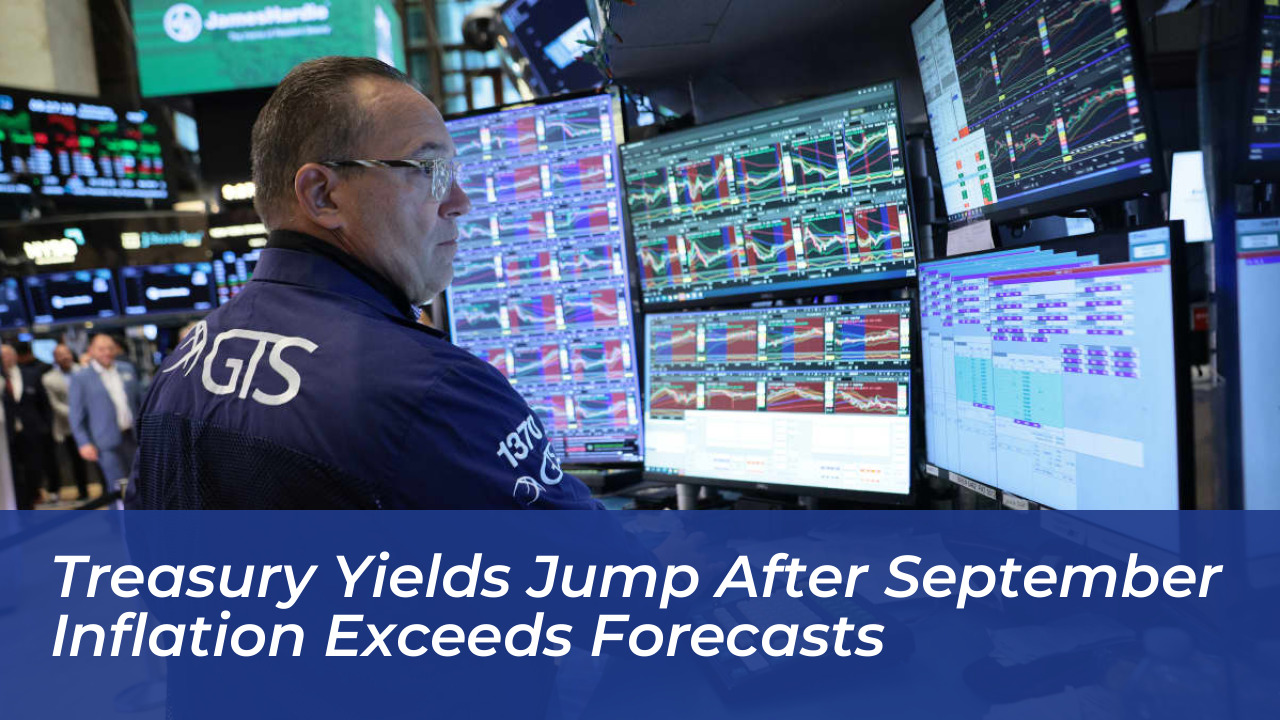

U.S. Treasury yields rose sharply on Wednesday, October 14, after September inflation figures came in above economists’ expectations. This pushed borrowing-cost benchmarks higher ahead of the Federal Reserve’s next interest rate decision. Persistent price pressures have renewed concerns across financial sectors regarding the future outlook for monetary policy.
The Consumer Price Index (CPI) increased by 3.7% year over year in September, exceeding the Dow Jones consensus forecast of 3.6%. Meanwhile, core inflation-which excludes volatile food and energy prices-reached 2.6% annually, compared with the expected 2.5% rate.
Impact on Treasury Yield Benchmarks
The 10-year Treasury yield climbed 10 basis points to reach 5.323%, hitting its highest level since October 8, when it touched 5.354%. As the primary benchmark for consumer loans, mortgages, auto loans, and credit card debt, movements in the 10-year note closely reflect broader macroeconomic sentiment.
Other key maturities also experienced notable upward movement:
- 30-Year Treasury Yield: Advanced 5 basis points to 5.61%.
- 2-Year Treasury Yield: Reached 4.94%, marking its highest level since September 29, closely tracking shifting expectations for Federal Reserve policy.
One basis point equals 0.01 percentage point, and bond prices generally move inversely to their corresponding yields.
Federal Reserve Policy Outlook and Market Reactions
The hotter-than-expected inflation print arrives just two weeks ahead of the Federal Reserve’s scheduled interest rate decision. Analysts note that sticky inflation may force the central bank to maintain higher interest rates for an extended period.
Following the data release, futures trading measured by CME’s FedWatch tool indicated that the odds of an October quarter-point rate hike jumped significantly. This reflects tighter financial conditions and rapid shifts in investor sentiment.
Broader Market Context and Upcoming Economic Data
Beyond consumer inflation, market participants are keeping a close watch on upcoming economic indicators. Scheduled releases for the week include the September reading for the producer price index (PPI), September retail sales data, and weekly initial jobless claims figures.
Market strategists continue to monitor heavy government and corporate debt issuance alongside energy price fluctuations. Together, these factors continue to exert upward pressure on long-term borrowing costs.