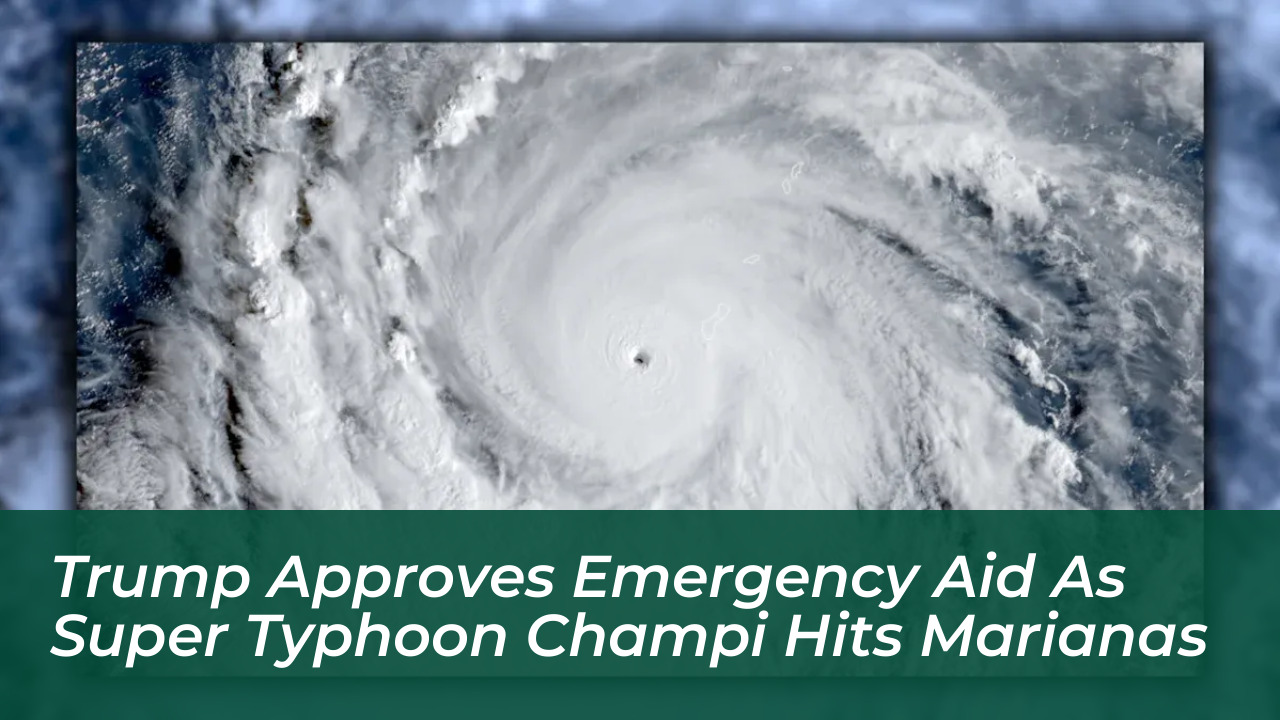

Federal emergency assistance is actively mobilizing across Guam and the Commonwealth of the Northern Mariana Islands (CNMI) as Super Typhoon Champi delivers destructive winds, heavy seas, and dangerous weather conditions to the western Pacific region. President Donald Trump formally approved emergency declarations requested by territorial governors, enabling the Federal Emergency Management Agency (FEMA) to coordinate critical support for public safety, property protection, and ongoing recovery operations.
According to White House and territorial announcements, the emergency declarations authorize federal agencies to deploy essential personnel, specialized equipment, and other vital resources to bolster local emergency operations. FEMA assistance is specifically intended to supplement territorial and local capabilities during the immediate crisis, with potential for additional federal designations to follow pending comprehensive damage assessments.
Presidential Declarations Target Guam and CNMI
The White House granted Guam Governor Lou Leon Guerrero’s request for a Presidential Emergency Declaration ahead of Champi’s closest approach to the island early Sunday, October 18, 2026. The powerful storm passed approximately 10 to 13 miles off Guam’s southern tip near Malesso at Category 4 strength around sunrise, generating powerful wind gusts and hazardous weather across the southern villages.
“We are grateful for the president’s quick response,” Governor Leon Guerrero stated following the announcement. “Along with our federal partners, we will continue seeing to the needs and protection and safety of our people.”
Lieutenant Governor Joshua Tenorio emphasized that the federal designation ensures full operational readiness as the territory addresses storm impacts. Similarly, CNMI fell under a matching presidential emergency declaration following Governor David Apatang’s formal request, as Champi’s formidable outer bands battered Saipan, Tinian, and Rota with damaging winds and heavy seas.
Emergency Framework and FEMA Deployment Details
Under the approved emergency framework, FEMA is authorized to identify, mobilize, and supply equipment and resources required to safeguard lives and property. Emergency protective measures, provided largely through direct federal assistance, carry a 75% federal funding share.
FEMA named William F. Roy as the federal coordinating officer for the ongoing response. Officials note that the current emergency declaration primarily focuses on immediate life-safety operations, public health protection, and emergency protective measures rather than broad household recovery grants, which require separate major disaster declarations.
Current Status of Local Infrastructure and Shelters
Guam remained under Condition of Readiness 1 (COR 1)-the island’s highest local alert level-keeping residents ordered indoors away from dangerous winds even as the storm center moved away. The U.S. Coast Guard established Port Heavy Weather Condition ZULU across Guam, Saipan, Tinian, and Rota, temporarily halting port operations.
Emergency shelter systems faced significant strain as the storm approached. Five Guam Department of Education shelters opened with a combined capacity of 1,964 people. Astumbo Elementary School reached full occupancy before the eyewall passed south of the island, prompting officials to direct evacuees to George Washington High School, Maria A. Ulloa, Machananao, and Talofofo Elementary schools.
Utility disruptions also affected parts of the territory. The Guam Power Authority reported that while critical facilities such as Naval Base Guam, Andersen Air Force Base, Camp Blaz, and Guam Memorial Hospital remained online, shifting winds knocked out several feeders, leaving portions of the island temporarily without power. Additionally, the Ugum Surface Water Treatment Plant shut down due to high turbidity caused by heavy storm runoff.
Recovery Outlook and Weather Updates
By Sunday evening, the National Weather Service in Guam reported that Super Typhoon Champi was tracking away from the Marianas, leading to the cancellation of all tropical-cyclone-related watches and warnings. However, meteorologists cautioned that lingering strong winds, elevated combined seas, and hazardous surf conditions would persist.
With life-safety threats beginning to subside, local authorities are transitioning into comprehensive assessment mode. Inspecting roads, clearing debris, restoring utility grids, and evaluating structural damage will dictate whether territorial leaders request broader federal designations in the days ahead.