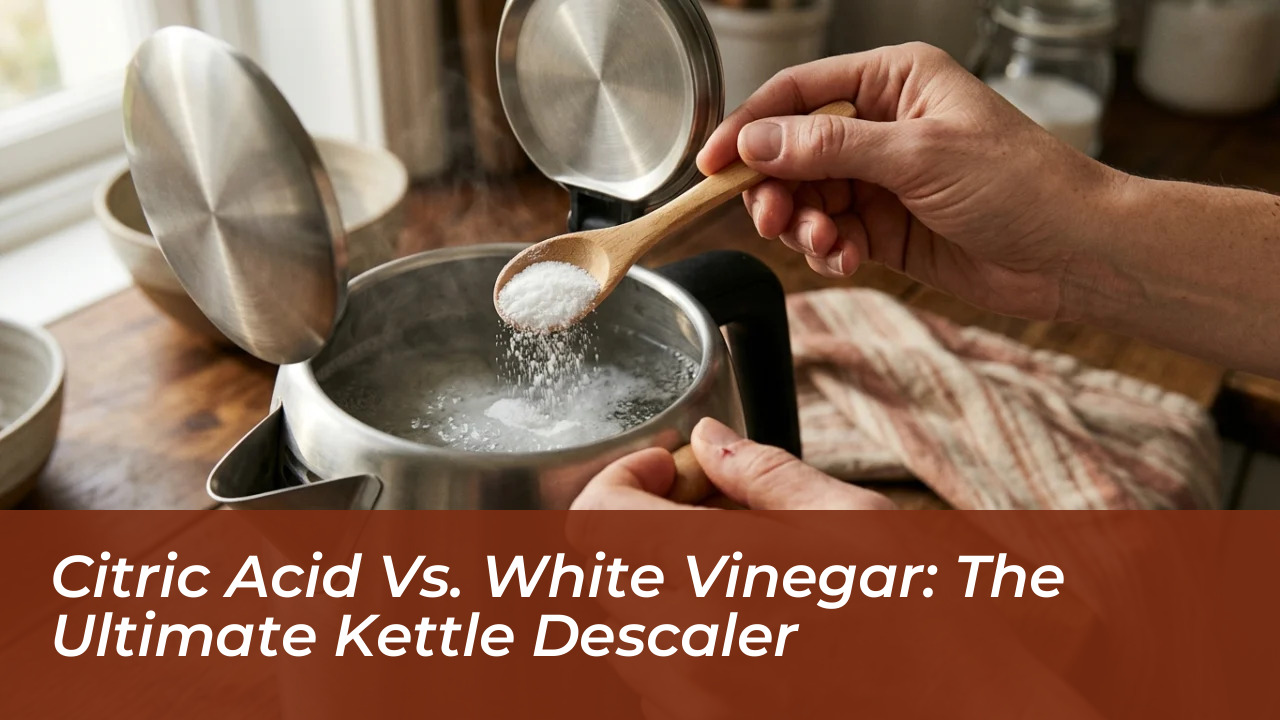

Hard water affects more than half of British homes, leaving behind chalky, off-white crusts composed primarily of insoluble calcium and magnesium carbonates. When water reaches boiling point inside a stainless steel kettle, these dissolved minerals precipitate out of solution and bind directly to the high-grade metallic base. Over time, this stubborn insulating barrier slows down heat transfer, drives up household energy consumption, and causes internal heating elements to overheat. While distilled white vinegar has long been the traditional pantry remedy, food-grade citric is rapidly proving to be the single most effective natural limescale remover for stainless steel kettles, breaking down heavy mineral deposits in under 20 minutes without the pungent, lingering stench of acetic .
The Chemistry of Descaling: Citric Versus White Vinegar
Both citric and white vinegar function by converting solid calcium carbonate into water-soluble salts and carbon dioxide gas. The chemical disparity, however, lies in their molecular structure and odour profile. White vinegar contains roughly 5% acetic , which produces volatile airborne compounds upon heating that readily absorb into silicone kettle gaskets and plastic lids. This requires prolonged boiling and multiple rinse cycles to purge lingering aromas from your morning tea.
Conversely, citric , derived naturally via industrial fermentation of sugars, is an organic tricarboxylic sold as dry crystalline granules. Because it contains three carboxyl groups rather than the single group found in acetic , it chelates mineral ions with exceptional efficiency. This chemical reaction dissolves thick mineral build-up cleanly at lower concentrations without boiling harsh, unpleasant fumes into your kitchen.
Performance Breakdown of Natural Descalers
- Powdered Citric : Dissolves thick limescale in 15 to 20 minutes; completely odourless and requires only a single clean rinse.
- Distilled White Vinegar: Effective at dissolving crusts but emits potent vapours and requires multiple boil cycles to remove lingering taints.
- Fresh Lemon Juice: Moderately effective on light scale; natural sugars risk caramelising on bare heating plates if overheated.
- Bicarbonate of Soda: An alkaline compound that cannot chemically dissolve calcium carbonate scale despite widespread internet myths.
Busting the Bicarbonate Myth: Why Alkaline Cleaners Fail
A widespread misconception circulating across social media claims that a cleaning paste made of bicarbonate of soda will eliminate kettle scale. In practical chemistry, this approach is fundamentally flawed. Calcium carbonate is an alkaline mineral deposit; it requires a compound with a low pH to neutralise and dissolve its chemical bond.
Applying bicarbonate of soda merely adds another alkaline compound to an already basic mineral crust. While combining bicarbonate of soda with vinegar produces dramatic fizzing, the and base simply neutralise one another, yielding water, carbon dioxide, and sodium acetate. That chemical reaction depletes the active before it can break down the stubborn mineral build-up clinging to the steel walls.
, harsh abrasive scouring powders or steel wool pads scratch the protective chromium oxide layer on stainless steel. Once that passive layer is compromised, underlying iron becomes susceptible to surface rust and pitting corrosion.
Step-by-Step: How to Descale a Stainless Steel Kettle Naturally
Executing an effective, food-safe descale takes minimal effort and protects delicate internal seals from chemical degradation. Follow this straightforward method to restore a stainless steel kettle to factory shine:
- Measure the solution: Fill the kettle halfway with cold tap water, typically around 750 millilitres to one litre, ensuring the heating plate and any exposed scale are fully submerged.
- Add the active agent: Stir in two heaped tablespoons (approximately 30 to 40 grams) of food-grade citric crystals until partially dissolved.
- Bring to a gentle boil: Switch the kettle on and allow it to reach a boil, then immediately turn off the power and unplug the appliance from the mains.
- Allow contact time: Leave the hot solution undisturbed for 15 to 20 minutes while the breaks apart stubborn calcium bonds. For extreme build-up, let it stand for up to 45 minutes.
- Rinse and inspect: Pour the liquid away down the kitchen drain, which helps clear mineral residue from pipework as well. Rinse the interior thoroughly with cold tap water twice before normal use.
Harsh industrial descalers containing sulphamic or hydrochloric acids pose unnecessary risks to domestic plumbing and can degrade the internal seals of domestic kettles over repeated applications. Adopting this routine on a set schedule prevents heavy encrustation that degrades heating efficiency. In hard water areas across southern and eastern England, treating the kettle once every three to four weeks maintains peak boiling speed and stops unsightly flakes from floating into freshly brewed beverages.
Frequently Asked Questions About Descaling Kettles
Is citric stronger than white vinegar for limescale?
Yes, at the same concentration, citric is the stronger . Its first dissociation sits near a pKa of 3.1 versus about 4.76 for the acetic in vinegar. A lower pKa means superior descaling power, allowing citric to clear heavy scale faster on heated appliances.
Will citric damage the rubber seals inside my kettle?
Citric is actually much kinder to rubber seals and gaskets than repeated exposure to white vinegar. However, it is still an , so you should never leave descaling solutions sitting inside the appliance for hours longer than recommended, and always complete a fresh water rinse.
Can I use fresh lemon juice instead of powdered citric ?
While fresh lemon juice contains natural citric , it also contains pulp, sugars, and fruit oils. When boiled inside a hot kettle, these trace sugars can scorch against the stainless steel element, creating a sticky residue that attracts fresh mineral deposits even faster.
How often should I descale my kettle in hard water areas?
In hard water regions with high mineral content, you should descale your stainless steel kettle every three to four weeks. Regular light maintenance prevents thick, calcified layers from forming and protects your appliance heating element from premature burnout.
Is it safe to pour used descaling solution down the drain?
Yes, once the citric has reacted with the calcium carbonate and neutralized during the 20-minute soak, the remaining liquid is safe to pour down standard kitchen drains and can even assist in clearing minor mineral residue from domestic pipework.