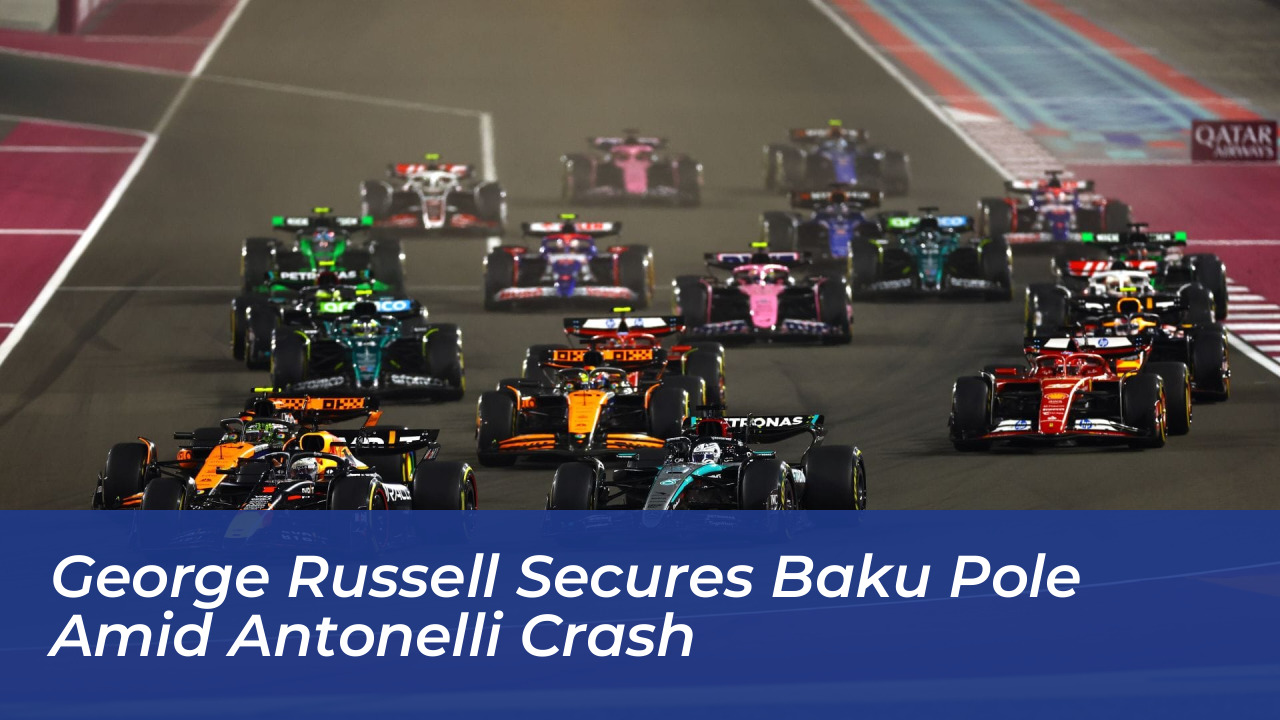
George Russell delivered a masterclass around the punishing asphalt of the Baku City Circuit, claiming his fifth pole position of the 2026 Formula 1 season during the Azerbaijan Grand Prix qualifying session. Russell extracted every ounce of performance from his Mercedes W17, culminating in a blistering final lap time of 1m 42.526s. This stellar performance left the competition trailing in his wake, establishing a staggering eight-tenth advantage over his nearest challenger. While Russell celebrated a milestone afternoon, the session brought intense drama for the Silver Arrows garage. Championship leader Andrea Kimi Antonelli suffered a high-profile crash in the opening segment, leaving Russell as the sole Mercedes representative in the battle for pole. The resulting grid shake-up paves the way for a volatile race day as frontrunners fight through traffic on one of the calendar’s most unforgiving street circuits.
- Qualifying Drama Unleashed in Q1
- Early Chaos and Track Conditions
- Aston Martin Nightmare and Backmarker Struggles
- Antonelli Hits the Wall at Turn 1
- The Rookie Mistake
- Championship Implications
- Red Bull and Audi Struggles
- Max Verstappen Mechanical Woes
- Audi Lacks Straight-Line Speed
- Fierce Midfield Battles Shape Q2
- Williams and Alpine Surge
- Elimination Heartbreak
- Russell Seals Dominance in Q3 Shootout
- The Four-Constructor Showdown
- The Record-Breaking Pole Lap
- Starting Grid Breakdown for the Azerbaijan Grand Prix
- The Top Ten Grid Order
- Strategic Outlook for Race Day
- Tactical Challenges on the Baku Streets
Qualifying Drama Unleashed in Q1
Early Chaos and Track Conditions
The 18-minute opening qualifying segment set a chaotic tone for the afternoon. A brief pre-session delay allowed marshals to clear debris from supporting racing categories, but the green light immediately triggered frantic track activity. Drivers rushed out on soft compound tires to secure a banker lap before inevitable yellow or red flags disrupted the rhythm. Track evolution happened at an extraordinary rate, forcing teams to keep their cars fueled for multiple consecutive laps.
Drivers fought for every inch of tarmac as dust and low-grip surfaces caught out veterans and rookies alike. Engineers barked lap time updates into team radios while drivers danced on the limit of adhesion. Braking stability proved elusive across the entire grid, especially heading into the sharp 90-degree corners that define the layout of the Baku City Circuit.
Aston Martin Nightmare and Backmarker Struggles
Aston Martin endured a nightmare start to proceedings. Lance Stroll locked his front tires heavily into the newly resurfaced Turn 7, sliding deep into the runoff area and triggering early yellow flags. Teammate Fernando Alonso encountered similar handling woes, compounding a miserable weekend for the Silverstone-based outfit. Both Aston Martin cars, alongside the Cadillac entries of Sergio Perez and Valtteri Bottas, found themselves anchored to the rear of the field.
Grid penalties for new power unit components further compounded their difficult weekend. The mechanics worked frantically in the garage between practice sessions, yet fundamental aerodynamic imbalances plagued both machines. Drivers complained of excessive bouncing and sluggish mid-corner rotation, making it nearly impossible to challenge the midfield runners.
Antonelli Hits the Wall at Turn 1
The Rookie Mistake
The defining incident of the opening phase arrived when Andrea Kimi Antonelli misjudged his entry into the tight Turn 1 left-hander. The Italian rookie clipped the inside barrier, snapping his front-left suspension and rendering his Mercedes W17 terminally damaged. Despite attempting to limp the wounded machine back to the pit lane, race engineer Peter Bonnington instructed Antonelli to switch off the engine and park in a safe location.
Debris scattered across the apex, forcing race control to deploy the red flags. Marshals cleared the carbon fiber shards while cranes lifted the stricken Mercedes away from danger. The mistake highlighted the razor-thin margin for error present on street tracks, where a millimeter of misjudgment brings an immediate end to a driver’s afternoon.
Championship Implications
Though Antonelli had already logged a time fast enough to scrape into the second qualifying segment, the mechanical failure cut his afternoon short. He watched the remainder of the session from the sidelines, securing a disappointing 16th place start. The blunder marks his first Q1 elimination of the 2026 campaign, creating a massive uphill battle for Sunday’s Grand Prix.
Rival teams immediately recognized the tactical shift this crash introduced to the weekend. Without Antonelli near the front to act as a strategic buffer or score heavy points, the drivers’ championship battle tightened up significantly. The young Italian now faces the daunting task of carving his way through a chaotic midfield on race day.
Red Bull and Audi Struggles
Max Verstappen Mechanical Woes
Max Verstappen endured a turbulent opening segment, venting over team radio regarding severe front-end bottoming that destroyed his braking stability. Despite the aerodynamic compromise, the Red Bull driver managed to piece together enough pace to survive the cut. Mechanics scrambled in the garage to adjust ride heights and wing angles before the next session.
The reigning world champion fought his car through every single apex, wrestling the steering wheel as the chassis slammed against the asphalt. Red Bull engineers analyzed telemetry data in real-time, attempting to find a compromise between high-speed straight-line stability and low-speed mechanical grip. Verstappen squeezed every ounce of potential from the RB22 just to stay inside the top ten.
Audi Lacks Straight-Line Speed
Further down the timing sheets, Audi suffered heavily on the high-speed Baku straights. Gabriel Bortoleto and Nico Hulkenberg lacked the straight-line efficiency required to match the midfield gains made by Williams. Both Audi cars exited in Q1, occupying 17th and 18th positions respectively.
Power unit deployment limitations and excessive drag crippled their performance along the main straight. Drivers expressed frustration over team radio as rival cars easily breezed past them using slipstream and optimal battery deployment. The engineering department faces a long night of analyzing drag configurations ahead of the race.
Fierce Midfield Battles Shape Q2
Williams and Alpine Surge
As the second segment commenced, track evolution accelerated rapidly. Teams fueled their cars for multiple consecutive laps to capitalize on the rubbering asphalt. Williams capitalized on a substantial upgrade package, allowing Carlos Sainz to drag his FW48 into Q3 contention with a brilliantly judged effort.
Alpine showcased promising race pace, with Pierre Gasly and Franco Colapinto extracting strong performances from their power units. Colapinto snatched a vital top-ten appearance in the dying seconds, edging out Haas driver Oliver Bearman. The garage erupted in celebration as the Argentine driver secured his spot in the pole shootout.
Elimination Heartbreak
Racing Bulls endured a frustrating afternoon, with Liam Lawson eliminated in 12th place and rookie Arvid Lindblad managing only 15th after battling handling inconsistencies. Traffic in the final sector ruined several fast laps, leaving drivers slamming their steering wheels in disappointment.
| Position | Driver | Constructor |
|---|---|---|
| 11th | Oliver Bearman | Haas |
| 12th | Liam Lawson | Racing Bulls |
| 13th | Alex Albon | Williams |
| 14th | Esteban Ocon | Haas |
| 15th | Arvid Lindblad | Racing Bulls |
Russell Seals Dominance in Q3 Shootout
The Four-Constructor Showdown
The final pole position shootout featured four distinct constructors vying for supremacy: Mercedes, Ferrari, McLaren, and Red Bull. Initial flying laps saw the McLaren duo of Lando Norris and Oscar Piastri briefly surge to the provisional top spot. Piastri displayed immense composure, putting his painful 2025 Baku qualifying memories behind him with a clean 1m 43.571s effort.
Tension filled the pit lane as teams monitored sector times flashing across the timing monitors. Ferrari engineers urged Charles Leclerc to find extra tenths in the twisty castle section, while McLaren strategists calculated optimal tire temperatures for a second flying lap. The battle for supremacy remained entirely open heading into the final minutes.
The Record-Breaking Pole Lap
Russell, however, remained untouchable. Unfazed by the papaya surge, the British driver unleashed a sensational final run. He swept through the middle and final sectors with absolute precision, stopping the clock at 1m 42.526s.
The lap time proved nearly nine tenths faster than the rest of the field, highlighting a rare and supreme harmony between driver and machine on a street circuit. Fans in the grandstands rose to their applause as the timing screens confirmed the massive gap. Russell calmly radioed his team to acknowledge the stellar engineering effort behind the W17.
Starting Grid Breakdown for the Azerbaijan Grand Prix
The Top Ten Grid Order
Ferrari’s Charles Leclerc salvaged a lonely but effective second place, crossing the line eight tenths adrift of Russell’s benchmark. Oscar Piastri claimed third, missing out on second by a minuscule 0.001 seconds. Isack Hadjar delivered a stellar performance to secure fourth on the grid for Red Bull, marking an impressive return following a recent wrist injury.
Lando Norris settled for fifth after a costly lock-up on his final flying lap ruined his rhythm. Lewis Hamilton qualified sixth in the lead Ferrari, followed by Pierre Gasly in seventh. Max Verstappen managed only eighth after encountering energy deployment complications and running into yellow flags caused by Norris. Carlos Sainz rounded out a successful qualifying for Williams in ninth, while Franco Colapinto completed the top ten for Alpine.
| Position | Driver | Constructor | Qualifying Time |
|---|---|---|---|
| 1 | George Russell | Mercedes | 1:42.526 |
| 2 | Charles Leclerc | Ferrari | 1:43.363 |
| 3 | Oscar Piastri | McLaren | 1:43.364 |
| 4 | Isack Hadjar | Red Bull Racing | 1:43.500 |
| 5 | Lando Norris | McLaren | No improvement |
| 6 | Lewis Hamilton | Ferrari | 1:43.902 |
| 7 | Pierre Gasly | Alpine | 1:44.110 |
| 8 | Max Verstappen | Red Bull Racing | 1:44.081 |
| 9 | Carlos Sainz | Williams | 1:44.629 |
| 10 | Franco Colapinto | Alpine | 1:44.683 |
Strategic Outlook for Race Day
Tactical Challenges on the Baku Streets
Saturday’s race promises intense tactical battles throughout the field. George Russell holds a pristine platform to convert pole position into victory, which will significantly narrow his deficit in the drivers’ world championship standings. Managing safety car restarts will test his nerve, especially with no teammate nearby to run interference against charging rivals.
Max Verstappen starts down in eighth position and needs aggressive strategy calls to navigate early traffic safely. Tire degradation, wall proximity, and high-speed slipstreams will dictate race pace across 51 laps. Pit wall strategists must remain sharp to exploit safety car windows on a circuit notorious for high attrition rates.