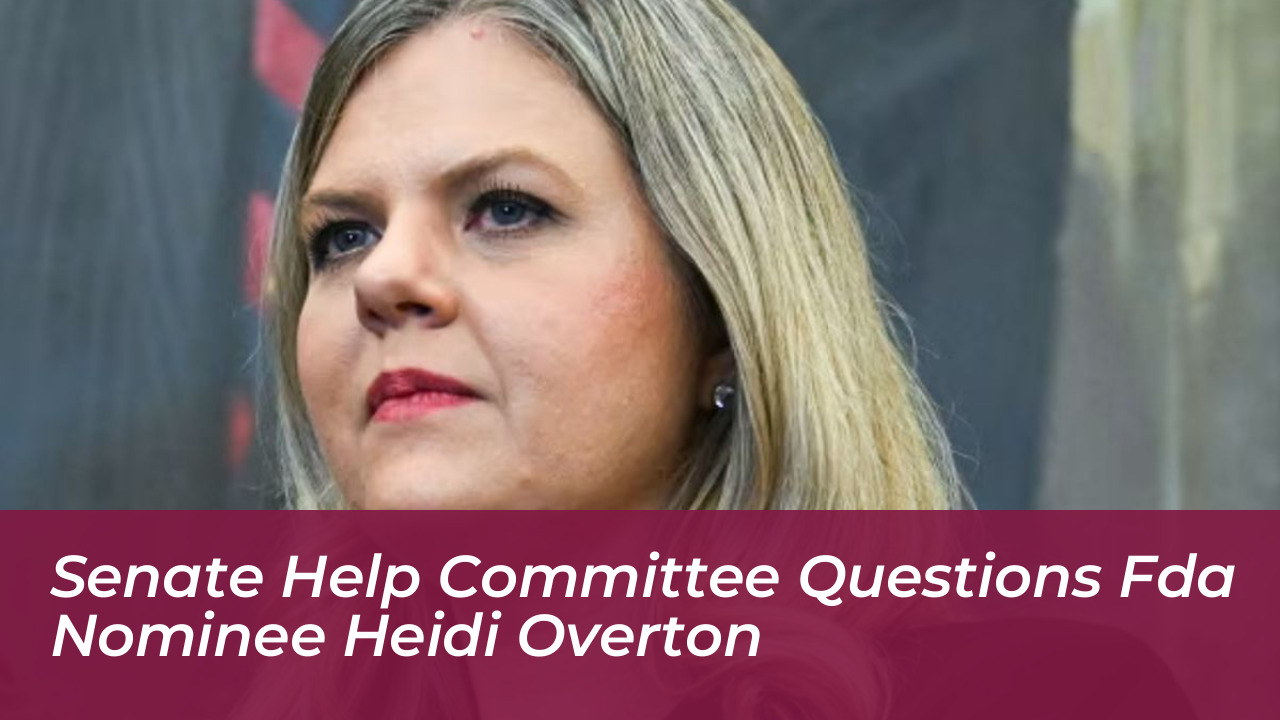
Members of the Senate Health, Education, Labor and Pensions Committee convened to question Dr. Heidi Overton, President Donald J. Trump’s nominee for Food and Drug Administration Commissioner. The high-stakes hearing addressed public health administration, pediatric immunization schedules, reproductive drug regulations, and food safety standards. Dr. Overton, a preventive medicine physician with a PhD in Clinical Investigation from Johns Hopkins, seeks to succeed Dr. Martin Makary. Lawmakers examined the philosophical divisions between committee members and the nominee, highlighting the tension between administration policy goals and statutory scientific standards.
- Introduction to the Senate HELP Committee Confirmation Hearing for Dr. Heidi Overton
- Professional Background and Policy Credentials of Dr. Heidi Overton
- Clinical Training and Academic Research
- Executive Policy Experience and Think Tank Tenure
- Agency Scope and Statutory Responsibilities Under 21 U.S.C. Section 393
- Pediatric Vaccines and National Immunization Policy Debates
- Chairman Bill Cassidy and the Measles, Mumps, and Rubella Defense
- Senator Ed Markey and the Contradictions of Flexible Immunization Schedules
- Regulatory Future of Mifepristone and FDA REMS Protocols
- Historical Evolution of Mifepristone Regulations from 2000 to 2021
- Senator Tammy Baldwin and Past Policy Positions on Chemical Abortion
- Senator Josh Hawley and Conservative Demands for Pre-2016 Restrictions
- Food Safety Operations and Foreign Inspection Deficits
- Structural Backlogs Within the FDA Human Foods Program
- Political Independence and Agency Credibility
- Insulating Career Scientists from Executive Branch Pressure
- Frequently Asked Questions
- What is the primary role of the FDA Commissioner?
- Who nominated Dr. Heidi Overton?
- What were the main concerns raised by senators during the hearing?
Introduction to the Senate HELP Committee Confirmation Hearing for Dr. Heidi Overton
The Senate confirmation process serves as an important constitutional check on executive appointments, but this specific session carried unique weight. Lawmakers faced a nominee whose professional background bridges rigorous academic research and prominent conservative policy advocacy. The discussion quickly moved past standard introductory pleasantries into contentious debates over vaccines, abortion medications, and the structural integrity of federal food safety programs.
Public scrutiny remains high as federal health agencies navigate post-pandemic rebuilding efforts. Consumers, healthcare providers, and pharmaceutical executives are watching closely to see how the next commissioner will balance public trust with executive branch directives. Dr. Overton’s responses during the hearing provided a window into her operational priorities should she secure the leadership post.
Professional Background and Policy Credentials of Dr. Heidi Overton
Clinical Training and Academic Research
- Medical degree and surgical residency foundation providing direct patient care experience.
- PhD in Clinical Investigation from the Johns Hopkins University School of Medicine.
- Focus on empirical research methods, statistical analysis, and clinical trial evaluation.
Executive Policy Experience and Think Tank Tenure
- Service as a White House Fellow during the first Trump administration.
- Chief Policy Officer and Vice Chair at the America First Policy Institute.
- Authorship of policy monographs targeting healthcare costs, administrative deregulation, and chemical abortion restrictions.
Agency Scope and Statutory Responsibilities Under 21 U.S.C. Section 393
- Oversight of products representing over twenty cents of every consumer dollar spent in the United States.
- Regulation spanning human and veterinary drugs, biologics, medical devices, cosmetics, and the national food supply.
- Legal obligation to protect public health by ensuring safety, efficacy, and security.
Dr. Overton’s supporters point to her academic credentials and firsthand knowledge of federal bureaucracy as ideal qualifications for the role. Her doctoral work at Johns Hopkins grounded her in the scientific method, while her tenure at the America First Policy Institute gave her sharp insights into regulatory reform. Critics, however, argue that her partisan policy advocacy compromises her ability to act as an objective, scientifically driven regulator.
Managing an agency the size of the Food and Drug Administration requires balancing complex legal mandates with rapid technological advancements. Under 21 U.S.C. Section 393, the commissioner must protect public health while advancing medical innovation. Dr. Overton testified that her decisions will rest on empirical safety and efficacy data, even as lawmakers questioned whether political pressures might override statutory requirements.
Pediatric Vaccines and National Immunization Policy Debates
Chairman Bill Cassidy and the Measles, Mumps, and Rubella Defense
- Committee Chairman Dr. Bill Cassidy questioned Dr. Overton regarding executive branch announcements suggesting reductions in pediatric vaccine schedules.
- Dr. Overton testified that the MMR vaccine is safe, effective, and serves as the primary tool against active measles outbreaks.
- Distinction drawn between individual product licensure and broader executive branch messaging.
Senator Ed Markey and the Contradictions of Flexible Immunization Schedules
- Democratic lawmakers challenged Dr. Overton regarding previous support for allowing parents to split combination shots into separate doses.
- Senator Ed Markey argued that splitting shots increases clinical visit burdens and drops community vaccination rates below the 95 percent herd immunity threshold.
- Dr. Overton defended flexible clinical scheduling as an operational strategy to prevent total parental abandonment of pediatric immunization.
The exchange over pediatric vaccines highlighted deep anxieties among public health advocates. Chairman Cassidy, a physician, pressed the nominee to defend established science against skepticism originating from within the executive branch. While Dr. Overton firmly endorsed the safety of the MMR vaccine during the hearing, her previous policy statements on flexible scheduling left room for intense questioning.

Senator Markey emphasized that public health policy must rely on population-level immunity data rather than parental preference alone. Dropping below the herd immunity threshold risks resurgence of preventable diseases. Dr. Overton countered that rigidity in public health mandates can backfire, driving skeptical parents away from the healthcare system entirely. She presented operational flexibility as a pragmatic way to maintain baseline vaccination rates.
Regulatory Future of Mifepristone and FDA REMS Protocols
Historical Evolution of Mifepristone Regulations from 2000 to 2021
- Initial FDA approval in 2000 under a Risk Evaluation and Mitigation Strategy.
- Regulatory shifts between 2016 and 2021 increasing the gestational age limit from 7 to 10 weeks.
- Elimination of in-person dispensing requirements and permanent authorization of telemedicine and mail-order pharmacy delivery.
Senator Tammy Baldwin and Past Policy Positions on Chemical Abortion
- Senator Tammy Baldwin questioned Dr. Overton regarding a 2023 policy paper characterizing chemical abortion regimens as unsafe.
- Dr. Overton outlined the current approval status of mifepristone and confirmed ongoing internal safety audits.
- Commitment to reviewing post-market adverse event reporting systems and REMS adequacy upon confirmation.
Senator Josh Hawley and Conservative Demands for Pre-2016 Restrictions
- Senator Josh Hawley pointed to online vendor non-compliance and reporting gaps in state-level data.
- Urging the nominee to restore pre-2016 restrictions, including mandatory in-person physician visits and physical drug pickup.
- Dr. Overton emphasized adherence to the formal administrative record and ongoing risk assessments managed by career scientists.
Reproductive healthcare policies sparked some of the most emotionally charged debates of the confirmation hearing. Senator Baldwin focused on Dr. Overton’s previous written work at the America First Policy Institute, where she labeled chemical abortion drugs unsafe. Dr. Overton maintained that her administrative actions as commissioner would be guided by the formal administrative record and ongoing internal safety reviews rather than past advocacy.
Conservative senators like Josh Hawley pushed for an immediate rollback of the 2016 and 2021 regulatory relaxations that permitted telemedicine prescriptions and mail delivery of mifepristone. They cited compliance issues among online vendors and gaps in adverse event reporting. Dr. Overton pledged to review post-market safety data carefully, though she avoided committing to specific policy rollbacks prior to reviewing formal agency audits.
Food Safety Operations and Foreign Inspection Deficits
Structural Backlogs Within the FDA Human Foods Program
- Ranking Member Bernie Sanders and Senator Lisa Murkowski highlighted severe operational strains in domestic and imported food oversight.
- Data demonstrating a 35 percent decline in overseas facility inspections compared to pre-2019 baseline levels.
- Foreign production plants operating for years without direct physical audits from FDA inspectors.
| Metric / Focus Area | Historical Baseline (2019) | Current Operational Level (2026) |
|---|---|---|
| Overseas Facility Audits | Pre-pandemic peak inspection frequency | Over 35% reduction in direct physical audits |
| Human Foods Program Oversight | Legacy fragmented divisional structure | Restructured unitary HFP facing structural backlogs |
| Imported Produce & Seafood Compliance | Routine port-of-entry and foreign site sampling | Increased reliance on paper verification and data sharing |
Beyond pharmaceuticals, lawmakers raised urgent concerns regarding the safety of the national food supply. Senators Sanders and Murkowski pointed to staggering inspection deficits for foreign manufacturing and agricultural facilities. With a thirty-five percent drop in overseas audits compared to pre-pandemic levels, imported seafood, produce, and processed goods enter the American market with less direct oversight than statutory guidelines require.

The newly restructured Human Foods Program faces intense pressure to clear these inspection backlogs. Dr. Overton acknowledged the operational strain during questioning and agreed that restoring robust domestic and international inspection protocols is vital for consumer protection. Senators from agricultural states made it clear that food safety will remain a primary benchmark for evaluating the effectiveness of her tenure.
Political Independence and Agency Credibility
Insulating Career Scientists from Executive Branch Pressure
- Lawmakers pressed Dr. Overton on her commitment to maintaining agency autonomy against political interference from the White House and Department of Health and Human Services.
- The challenge of restoring public trust in federal health institutions following pandemic-era controversies.
- Dr. Overton pledged to base regulatory actions strictly on statutory standards and empirical scientific evidence.
The overarching theme of the hearing centered on institutional credibility. Decades of public trust have been eroded by perceived political interference in regulatory decisions, ranging from drug approvals to vaccine guidelines. Senators across the political spectrum demanded assurances that Dr. Overton would protect career scientists from political pressure.
Dr. Overton reiterated her commitment to following the law and relying on empirical data. Whether those assurances satisfy a divided Senate remains to be seen as the committee prepares for its upcoming confirmation vote. Her ability to navigate the tension between executive policy goals and scientific independence will define her legacy if she takes the helm at the Food and Drug Administration.
Frequently Asked Questions
What is the primary role of the FDA Commissioner?
The commissioner oversees the regulation of human and veterinary drugs, medical devices, food safety, and tobacco products to protect public health.
Who nominated Dr. Heidi Overton?
President Donald J. Trump nominated Dr. Overton to lead the federal agency.
What were the main concerns raised by senators during the hearing?
Lawmakers focused heavily on pediatric vaccination schedules, reproductive medication regulations, and foreign food inspection backlogs.