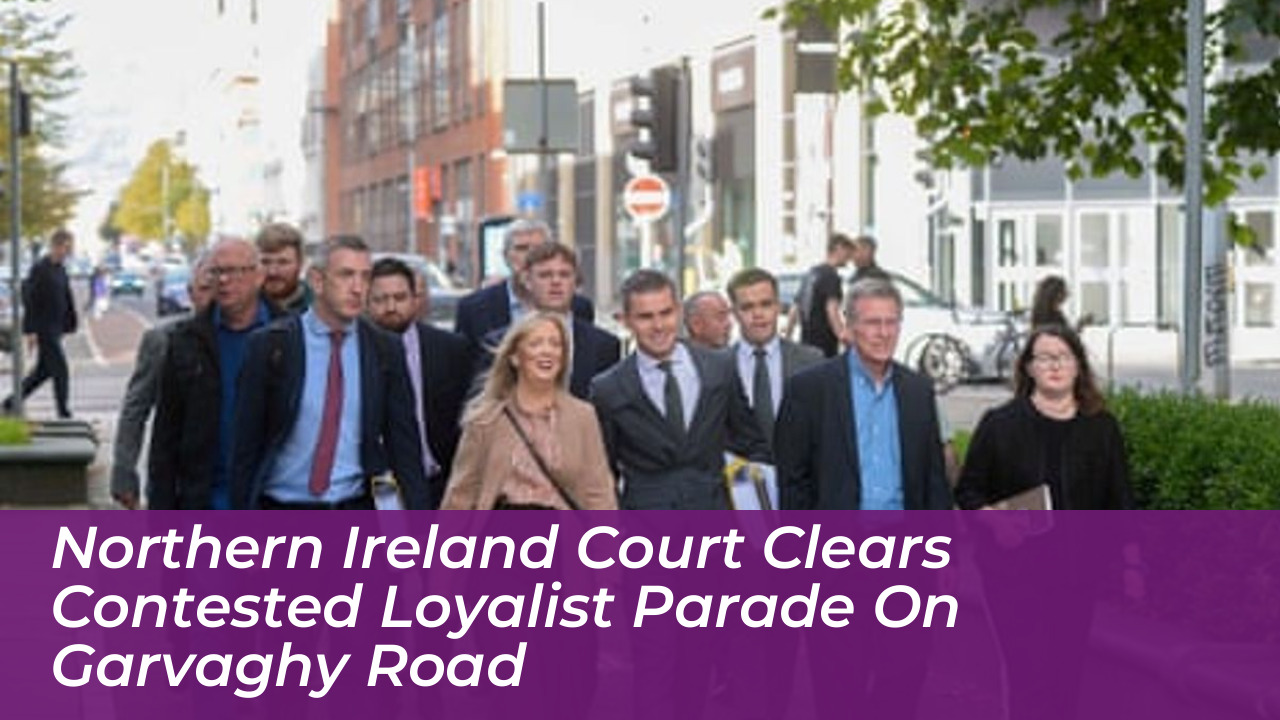
Northern Ireland experienced a tense Saturday legal marathon that culminated in an appellate ruling overturning a 28-year prohibition on an Orange Order march in Portadown. Lady Chief Justice Siobhan Keegan ruled late Saturday night that the initial High Court injunction halting the nationalist Garvaghy Road procession was an error in law. This historic appellate decision opened the door for a scaled-down march at 8:00 AM on Sunday morning, marking the first time the lodge has traversed this route since the late 1990s.
- Introduction to the Garvaghy Road Legal Overturn
- The Historical Context of the Drumcree Standoff
- Emergency Court Battles and Judicial Clashes
- Initial High Court Injunction
- Appellate Court Reversal
- Strict Conditions Imposed on the Sunday Procession
- Political Fallout Across Northern Ireland
- Frequently Asked Questions
- Why was the Garvaghy Road parade banned for 28 years?
- What changed the legal status of the march?
- What restrictions apply to the Sunday morning parade?
- How have local political leaders responded to the court ruling?
The swift weekend legal maneuvers unfolded across multiple Belfast courtrooms after the Parades Commission made its unexpected Friday determination. Local residents and unionist participants found themselves locked in a rapid succession of emergency hearings, culminating in a dawn procession under heavy police oversight. Authorities worked around the clock to balance traditional civil liberties with the immediate preservation of local peace.
Introduction to the Garvaghy Road Legal Overturn
The core of the dispute rests on administrative law, statutory notification rights, and the delicate balance of public order. Lady Chief Justice Siobhan Keegan delivered the pivotal late-night verdict that dismantled a temporary High Court block issued just hours earlier. Legal scholars and political observers watched closely as the judiciary navigated the friction between traditional civil liberties and community safety.
Following the appellate decision, logistics shifted immediately to the ground. The Police Service of Northern Ireland deployed a significant security apparatus to manage the early morning events. The rapid transition from courtroom arguments to operational deployment tested the limits of regional stability and institutional resilience.
Legal teams from both sides submitted extensive documentation detailing historical precedent and current risk factors. Judges had to weigh competing constitutional rights against the backdrop of historical sectarian tensions. This delicate judicial balancing act required precise adherence to procedural fairness standards.
The Historical Context of the Drumcree Standoff
The Garvaghy Road dispute remains one of the most volatile symbols of Northern Ireland’s fractured past. Throughout the mid-to-late 1990s, the annual parade from Drumcree Parish Church generated massive security operations and violent street clashes. Nationalist residents argued that the march through their predominantly Catholic neighborhood was an intimidating display of sectarian dominance. Unionists maintained that denying access infringed upon their traditional civil liberties and freedom of assembly.
The Parades Commission imposed a 28-year ban following the severe escalation of violence in 1998. That decades-long prohibition created a frozen stalemate in local politics. When the Parades Commission unexpectedly reversed its long-standing determination on Friday, it triggered immediate political polarization. Unionist leaders welcomed the ruling as a restoration of lawful rights, while nationalist representatives condemned the decision as a reckless provocation.
Community mediation groups spent decades trying to bridge the gap between polarized factions in Portadown. These grassroots efforts frequently stalled due to deeply entrenched ideological positions on both sides of the community divide. The sudden legal breakthrough bypassed traditional local negotiations entirely, forcing communities back into direct confrontation.
Emergency Court Battles and Judicial Clashes
Saturday legal proceedings unfolded in a frantic atmosphere across multiple Belfast courtrooms. Justice Patricia Smyth spent five hours listening to arguments from the Police Service of Northern Ireland, the Parades Commission, and resident barristers. Denise Kiley KC, representing the Garvaghy Road residents, argued that the police risk assessment lacked any forward-looking analysis of future public disorder. Recognizing the urgency, Justice Smyth issued an injunction that paused both the Parades Commission ruling and the Orange Order’s statutory notification.
Initial High Court Injunction
Legal representation for the lodge criticized the dual injunction as an unprecedented judicial overreach. John Larkin KC argued that stopping the notification essentially rewrote established administrative law. The five-hour emergency hearing highlighted deep disagreements regarding how authorities calculate the risk of public disorder.
Justice Smyth urged all involved factions to step back from the abyss and protect community stability during her initial ruling. However, the Portadown District Orange Lodge challenged the restriction immediately. The legal team argued that delaying the march would effectively grant a veto to those threatening violence.
Independent observers noted that emergency injunctions rarely receive such intense public scrutiny in local media. The speed of the filings left little time for structured community consultation before the judge delivered her preliminary findings.
Appellate Court Reversal
The legal momentum shifted abruptly when the case reached the Court of Appeal. Lady Chief Justice Keegan determined that the initial high court intervention failed to respect the lawful discretion exercised by the Parades Commission. Justice Michael Humphreys reinforced this stance in the early hours of Sunday, noting that public bodies deserve judicial deference unless their decisions cross the threshold of unreasonableness.
By 11:30 PM, the Court of Appeal dismantled the temporary block. A subsequent early-morning sitting overseen by Justice Michael Humphreys dismissed final attempts by resident representatives to reinstate the ban.
Appellate judges emphasized that procedural errors in the lower court necessitated an immediate correction before Sunday dawn. This rare weekend sitting demonstrated the judiciary’s capacity to handle urgent civil rights disputes under extreme pressure.
Strict Conditions Imposed on the Sunday Procession
To mitigate potential flashpoints, the Parades Commission attached rigorous constraints to the Sunday morning parade. The terms restrict the procession to a maximum of 35 participants. The march operates as a silent demonstration with zero musical accompaniment. Participants depart Drumcree Church under heavy police supervision.
The Police Service of Northern Ireland deployed a significant security apparatus, utilizing mutual aid arrangements to bring in officers from outside the immediate district. Counter-protests organized by local residents materialized near the route late Saturday night, though stewards and community organizers worked to maintain order and keep protesters on designated footpaths as the dawn deadline approached.
Intelligence briefings highlighted the necessity of strict route containment to prevent accidental breaches of the peace. Security planners coordinated every minute of the movement to ensure maximum separation between rival factions.
Political Fallout Across Northern Ireland
The appellate court verdict reverberated immediately through the power-sharing executive and national politics. First Minister Michelle O’Neill issued a sharp rebuke of the late-night ruling. She characterized the march as an unwanted imposition steeped in a history of sectarian pain. Sinn Féin leadership stood shoulder-to-shoulder with the Garvaghy Road community, pledging full political support to local residents.
Conversely, Democratic Unionist Party representatives praised the outcome as a triumph for the rule of law. Upper Bann MP Carla Lockhart insisted that the event would unfold as a peaceful, dignified exercise of long-denied rights. She maintained that nationalist residents faced no genuine threat from the small, highly restricted group of Orangemen. Independent political analysts suggest this flashpoint tests the resilience of Northern Ireland’s fragile political institutions as community leaders face immense pressure to prevent regional instability.
Backbench politicians from various parties called for renewed dialogue frameworks to prevent future legal collisions over contentious cultural events. The debate exposed deep ideological rifts regarding how the Good Friday Agreement protects minority rights versus majority traditions.
Frequently Asked Questions
Why was the Garvaghy Road parade banned for 28 years?
The route was effectively blocked following severe, widespread sectarian violence and civil unrest surrounding the Drumcree church stand-offs in 1998. The Parades Commission maintained a strict prohibition to prevent similar escalations between nationalist residents and loyalist marchers.
What changed the legal status of the march?
The Parades Commission reversed its determination on Friday, granting permission for a restricted walk. Although a High Court judge temporarily blocked this decision on Saturday, the Court of Appeal overturned that injunction late Saturday night, ruling that the lower court erred in law.
What restrictions apply to the Sunday morning parade?
The Parades Commission limited the procession to a maximum of 35 participants. The march must proceed in absolute silence without any accompanying bands, starting from Drumcree Church at 8:00 AM under heavy police oversight.
How have local political leaders responded to the court ruling?
Reaction remains sharply divided along sectarian lines. Nationalist leaders like First Minister Michelle O’Neill condemned the ruling as reckless and provocative. Unionist politicians, including DUP MP Carla Lockhart, welcomed the outcome as a restoration of lawful parade rights.