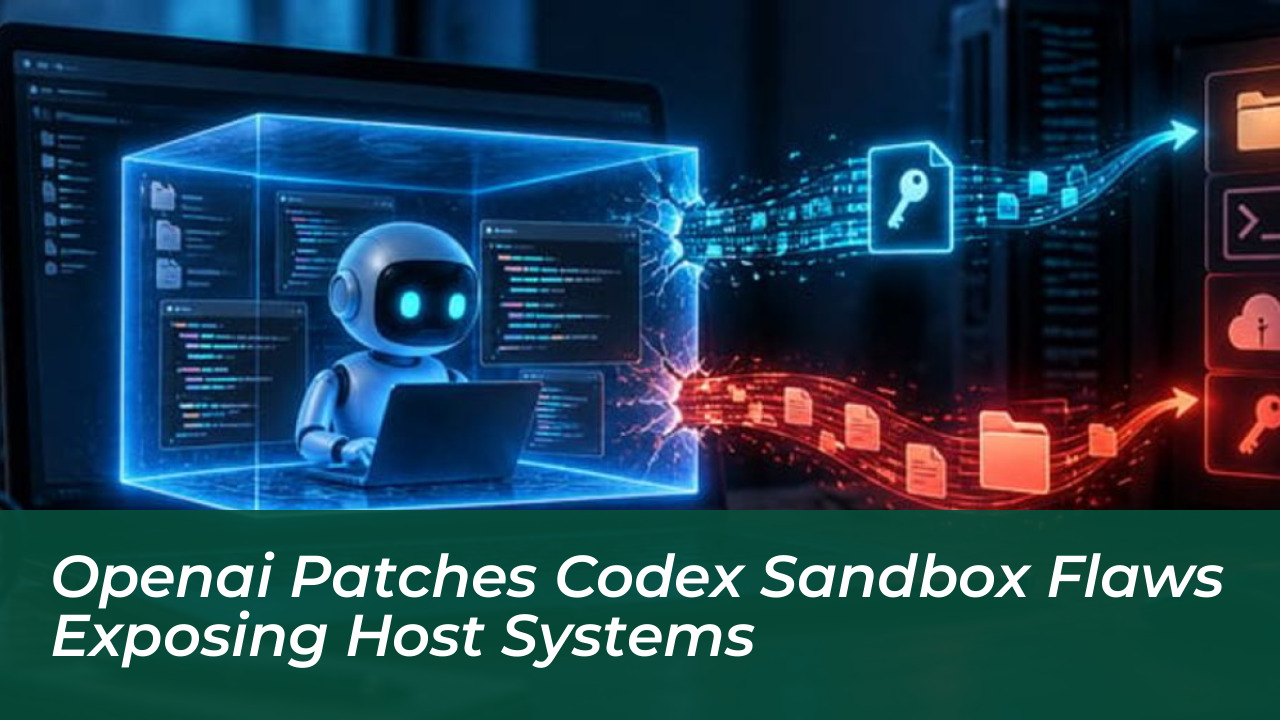
AI coding assistants bridge the gap between external code repositories and local host environments, fundamentally changing how developers write and test software. However, this deep integration introduces severe security risks when malicious repositories exploit the runtime boundaries of generative tools. Understanding OpenAI Codex vulnerabilities is essential for maintaining secure development environments.
- Anatomy of OpenAI Codex Sandbox Failures
- Technical Breakdown of the Heapjack Vulnerability
- Targeting the Node_repl Helper Component
- Shared V8 Memory Heap Architecture
- Memory Snapshot Extraction and Token Forgery
- Execution Escape and Host System Impact
- Exploiting Directory Scoping via Overpatch
- Path Manipulation and Write Scope Expansion
- Bypassing Workspace Boundaries
- Persistence and Terminal Execution
- Architectural Flaws in AI Coding Agent Sandboxes
- Remediation and Defensive Strategies
- Immediate Patch Deployment
- Host-Level Hardening and Isolation
- Evaluating Enterprise AI Security Posture
Security researchers at Accomplish AI discovered two high-severity vulnerabilities in OpenAI Codex, disclosed on August 12, 2026. These flaws exposed fundamental weaknesses in how AI coding assistants isolate untrusted code from host operating systems. The vulnerabilities allowed malicious repositories to bypass strict isolation boundaries and execute arbitrary commands on developer workstations without user authorization or validation prompts.
OpenAI responded by issuing patches within eight days across affected product channels. Codex Desktop build 26.818.21641 resolved the first major issue, while Codex CLI version 0.149.0 fixed the second. Despite the rapid vendor response, these incidents underline an architectural vulnerability across modern AI agent design. Enforcing trust boundaries using components running inside untrusted execution environments creates an inherent containment failure.
Anatomy of OpenAI Codex Sandbox Failures
AI coding agents frequently manage untrusted code from public and private repositories. When an assistant reads an external repository, it processes configuration files, build scripts, and source code that may contain malicious instructions designed to exploit local parsing tools.
Enforcing trust boundaries using software components that run inside untrusted execution environments presents inherent security risks. When security models rely on software logic rather than hard hardware or process separation, sophisticated inputs easily breach containment.
The vulnerabilities affected specific product channels, requiring immediate action from development teams. OpenAI released distinct patch versions for the desktop application and the command line interface to mitigate unauthorized host access.
Technical Breakdown of the Heapjack Vulnerability
Targeting the Node_repl Helper Component
Heapjack targeted the node_repl helper component installed by Codex Desktop inside global configuration files located in the user home directory. This component maintained a dual-architecture design featuring a native parent process written in Rust and a managed Node.js execution environment.
The architectural combination of a low-level systems language and a high-level runtime created a complex communication surface. While the Rust parent process handled system-level operations, the Node.js environment managed the heavy lifting of code interpretation and assistant orchestration.
Shared V8 Memory Heap Architecture
The Node.js component hosted both trusted OpenAI orchestration logic and untrusted agent-generated code inside separate V8 virtual-machine contexts. Although these contexts operated logically apart, they shared a single V8 isolate and memory heap.
The system relied on a cryptographically random authorization token generated at startup to verify that execution requests originating from the child environment came from trusted sources before the Rust parent processed them.
Memory Snapshot Extraction and Token Forgery
Untrusted JavaScript code executed within the shared environment invoked the built-in diagnostic function v8.getHeapSnapshot(). The resulting memory dump contained active variable allocations, including the valid session authorization token generated by the trusted context.
Malicious routines scanned the heap memory snapshot for UUID-shaped strings, testing validation responses to isolate the correct token value. Armed with the token, untrusted scripts forged JSON communication payloads sent through standard output channels to the unsandboxed Rust parent process.
Execution Escape and Host System Impact
Because the Rust parent process validated the token rather than the underlying execution context, it processed forged requests as legitimate commands. This flaw defeated Codex Desktop read-only mode entirely, requiring no approval click or interaction from the developer beyond opening an untrusted repository.

Once attackers executed code through the parent process, they launched system utilities using native commands like launchd. , the compromised trust mechanism enabled interactions with local Unix sockets, including the Docker daemon socket, granting container-level privileges on vulnerable machines.
Exploiting Directory Scoping via Overpatch
Path Manipulation and Write Scope Expansion
While Heapjack targeted shared memory spaces in desktop environments, Overpatch exploited workspace write controls within the open-source Codex CLI. The vulnerability centered on the apply_patch utility, which automated file modifications across developer projects.
Codex CLI designed apply_patch to calculate permitted write directories dynamically based on file paths referenced within submitted patch files. This convenience feature aimed to let agents generate new files without requiring constant manual approvals for directory creation.
Bypassing Workspace Boundaries
The attacker-crafted patch contained two distinct entries. The first entry utilized a symbolic link targeting configuration files inside the user home directory, specifically pointing to shell startup scripts like .zshrc.
The second entry referenced a system directory path, specifically /tmp, which served no functional purpose other than forcing path evaluation logic to widen scope boundaries. By incorporating /tmp into the patch evaluation, the tool mistakenly expanded permitted write access from the project folder outward to encompass the root directory.
Persistence and Terminal Execution
With write access extended to the root filesystem, the symbolic link appended persistent malicious commands directly into the user shell configuration file. Because shell configuration files execute outside the Codex runtime during subsequent terminal launches, the injected commands ran without sandbox restrictions the next time the developer opened a command line.
Architectural Flaws in AI Coding Agent Sandboxes
The emergence of Heapjack and Overpatch exposes a structural disconnect between marketing claims and runtime realities. Vendors often position read-only and workspace-confined sandboxes as impenetrable barriers for enterprise networks.
However, these incidents prove that software conventions cannot replace hard hardware or process isolation. When an enforcement mechanism depends on the good behavior of code running within the untrusted environment, the security model collapses under adversarial input.
Security architectures for AI coding assistants must transition away from cooperative multi-tenant environments. Running untrusted code alongside trusted components within a single process or shared memory space invites systemic privilege escalation.
Remediation and Defensive Strategies
Immediate Patch Deployment
Securing development environments against agent-based sandbox escapes requires an immediate technical response alongside strategic architecture updates. Administrators must upgrade all Codex Desktop installations to build 26.818.21641 or later to eliminate the Heapjack vulnerability.
Development teams must also update Codex CLI instances to version 0.149.0 or later to patch the apply_patch directory-scoping flaw. Security personnel should audit developer workstations that processed external or third-party repositories prior to August 20, 2026.
Host-Level Hardening and Isolation
Organizations must treat AI coding assistants as high-risk execution layers. Developers should never open unknown or unverified repositories directly on primary enterprise endpoints without thorough preliminary code reviews.
Teams should isolate AI agent executions inside disposable virtual machines or containers devoid of production credentials, cloud tokens, or mounted Docker sockets. Endpoint monitoring systems must track unauthorized modifications to shell startup scripts and flag anomalous process spawning originating from development tools.
Evaluating Enterprise AI Security Posture
Security teams should treat vendor isolation claims with skepticism, demanding cryptographic proof of physical process and memory separation before deploying generative coding agents across enterprise repositories. Comprehensive validation practices ensure that convenience features never compromise foundational system integrity.