
Modern keyless entry systems have transformed how drivers access and start their vehicles, but they have also introduced a hidden security vulnerability. Vehicle thieves no longer need to break windows or tamper with ignition wires. Instead, they exploit the invisible radio frequencies constantly emitted by key fobs resting inside homes. Fortunately, security specialists note that a common household item-aluminum kitchen foil-acts as an effective electromagnetic shield against these drive-by relay thefts.
The Vulnerability Inside Modern Key Fobs
Factory key fobs continuously communicate with a vehicle receiver via radio frequency signals, typically operating at 315 MHz in North America and 433 MHz in Europe and Asia. Criminals exploit this passive transmission through a relay attack. In this setup, a pair of thieves uses handheld signal amplifiers to bridge the distance between a vehicle parked outside and a key fob resting on an indoor table.
Relay attacks work because the vehicle’s computer is tricked into believing the physical key is right next to the door handle. According to testing by the German General Automobile Club (ADAC), most keyless entry vehicles remain susceptible to this exploit. One thief stands near the exterior walls with a signal booster, while an accomplice stands beside the targeted vehicle. The booster captures the faint wireless signal from inside the house, strengthens it, and sends it to the car. The vehicle unlocks and the engine starts instantly, leaving zero physical evidence.
The Physics of the Faraday Shield
The science explaining why ordinary household foil protects car keys dates back to 19th-century physicist Michael Faraday. Wrapping an electronic device in conductive metal creates a Faraday cage, which blocks external electromagnetic fields from penetrating inside.
Aluminum is an exceptional electrical conductor. When incoming radio waves hit the metal barrier, they produce surface electrical currents that disperse along the exterior of the foil rather than reaching the remote’s internal microchip. The result is an immediate transmission blackout: the fob cannot broadcast an outgoing signal or detect incoming requests.
How to Prepare a Foil Barrier Properly
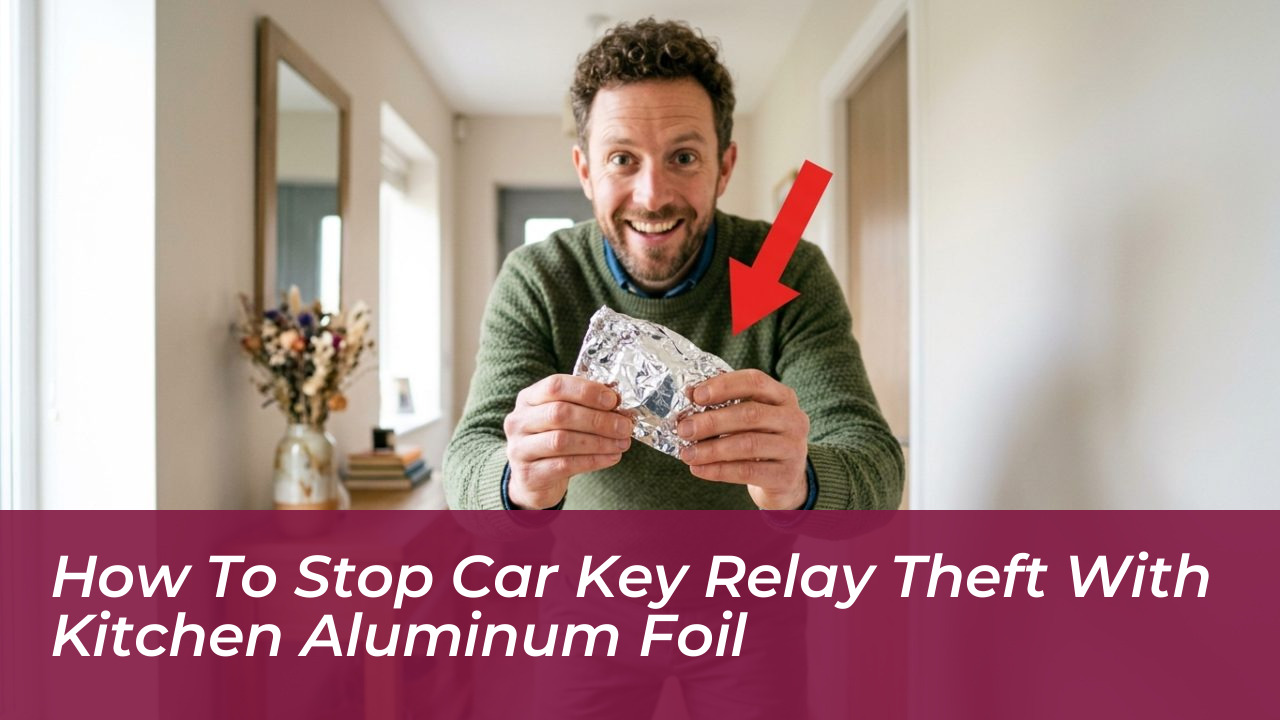
While standard kitchen aluminum foil blocks automotive radio frequencies, precision is key. A poorly wrapped remote allows radio leakage. Follow these steps for complete isolation:
- Complete Coverage: Cover the entire body of the remote so no plastic surfaces remain exposed.
- Multiple Layers: Wrap the fob in at least two to three continuous layers of aluminum foil.
- Tight Seams: Crimp and fold all edges tightly to eliminate any gaps or seams where wireless signals could escape.
- Signal Testing: Walk up to your locked vehicle while holding the wrapped remote and attempt to open the door handle to confirm the signal is blocked.
- Regular Maintenance: Inspect the foil regularly and replace it with fresh sheets once handling produces tears or loose seams.
Protection Method Performance Profile
Drivers can evaluate several common key shielding methods to balance cost and security:
- Multi-layer Aluminum Foil: Instant electromagnetic block; zero cost; requires periodic replacement due to tearing.
- Commercial RFID Pouch: Durable woven conductive lining; built for daily handling; involves a purchase cost.
- Deep Interior Metal Container: Solid physical barrier; shields keys indoors; requires dedicated storage discipline at home.
- Unprotected Key Fob: Exposes continuous 315/433 MHz broadcasts; highly vulnerable to digital amplification devices.
Layered Defenses Against Electronic Vehicle Theft
A common misconception is that factory immobilizers and standard alarms provide total protection against wireless theft. In reality, relay attacks bypass these features entirely because the vehicle registers the boosted transmission as an authorized entry command. A multi-layered defense strategy offers the most dependable safeguard.
Physical Wheel Locks
Mechanical steering wheel locks force electronic thieves to carry loud cutting equipment, neutralizing the stealth advantage of electronic bypass gear.
Strategic Indoor Storage
Avoid storing key fobs on entryway tables, key hooks near exterior doors, or windowsills. Storing keys deeper within interior rooms reduces signal strength reaching the perimeter.
Interior Metal Boxes
Placing shielded fobs inside an enclosed metal container, cookie tin, or dedicated drawer adds an extra physical barrier against signal boosters.
Passive Entry Deactivation
Certain vehicle models allow owners to disable passive keyless entry completely via dashboard configuration menus, shutting off automatic wireless responses until a button is pressed.
Parking Location
Leaving vehicles in well-lit, high-visibility driveways removes the cover of darkness thieves rely on during electronic scans.
Frequently Asked Questions
Will wrapping my car keys in aluminum foil damage them?
No. The foil acts as a passive electrical conductor that blocks radio frequencies without altering or interfering with the internal electronics of your key fob.
How many layers of aluminum foil are necessary to block signals?
For dependable signal blockage, use at least two to three tight layers of standard kitchen foil. Ensure there are zero gaps, holes, or unsealed seams.
Do newer cars with Ultra-Wideband (UWB) technology need foil shielding?
Newer vehicles equipped with Ultra-Wideband (UWB) technology measure the precise distance between the key and the car, rendering traditional relay attacks ineffective. However, UWB is still present in a minority of vehicles, making foil or Faraday pouches necessary for most drivers.
What is the difference between kitchen foil and a commercial Faraday pouch?
Kitchen foil is a free, temporary solution that requires daily re-wrapping and tears easily. Commercial Faraday pouches feature durable woven nickel-copper mesh and closures engineered for long-term daily convenience.
Where should I store my car keys at night if I don’t use foil?
If you do not wrap your keys, store them in the deep interior of your home-far away from exterior walls, front doors, windows, and attached garages-to prevent relay amplifiers from detecting their signals.